
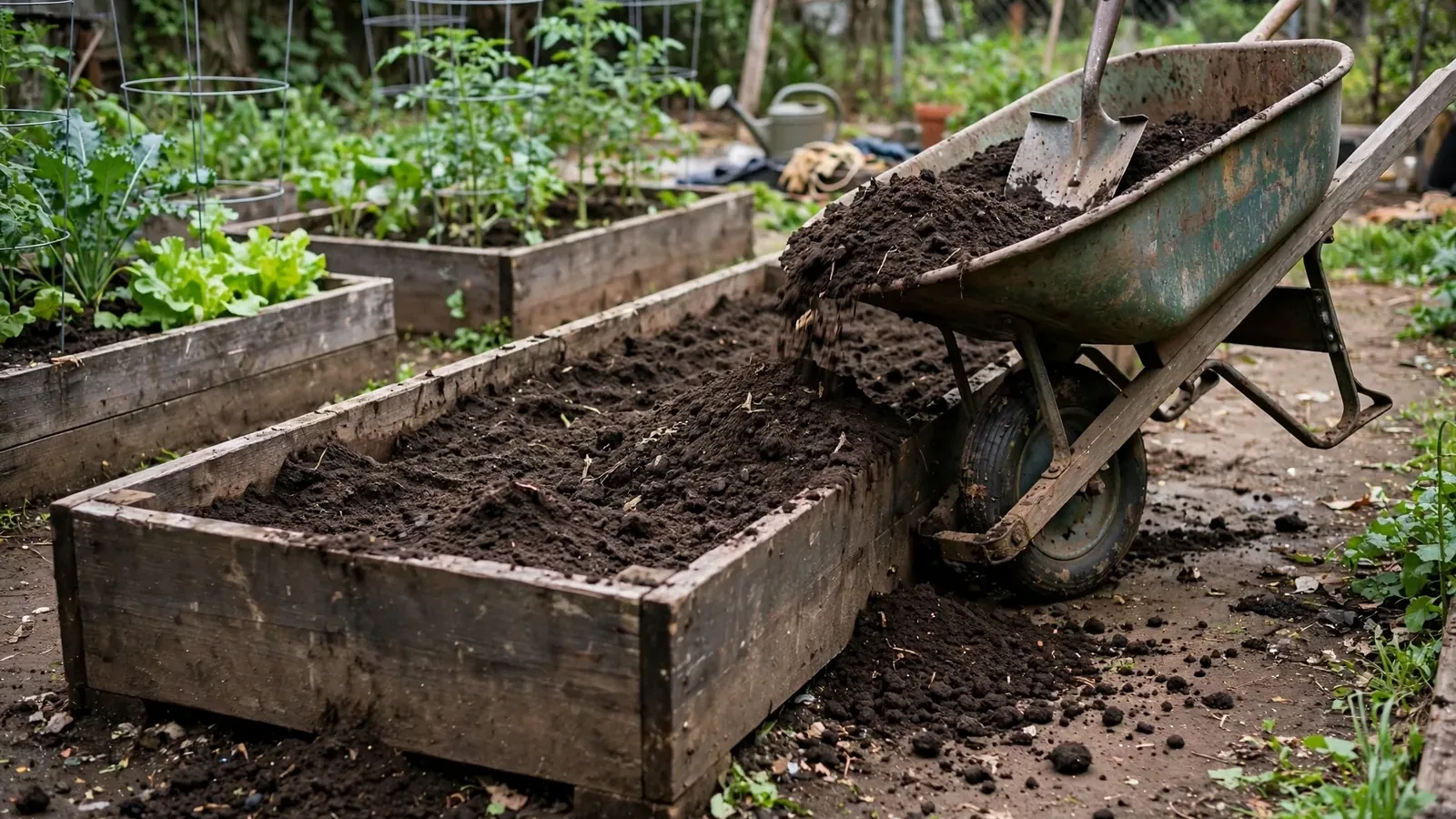
The 4×8 foot bed is the workhorse of home vegetable gardening — big enough for a serious harvest, narrow enough to reach the middle from either side. It’s also the bed size people ask about most, so let’s answer it properly: how much soil it takes at every common depth, what that costs in bags versus bulk, and the practical details that turn a number into a plan.
New to raised beds? Start with our Raised Bed Gardening Hub — every soil guide in one place.
The Quick Answer
| Soil depth | Cubic feet | Cubic yards | 1.5 cu ft bags* | |—|—|—|—| | 6 inches | 16 | 0.59 | 11 | | 8 inches | 21.3 | 0.79 | 15 | | 10 inches | 26.7 | 0.99 | 18 | | 12 inches | 32 | 1.19 | 22 |
*Bag counts rounded up, before a settling buffer.
The headline number most gardeners need: a 4×8 bed filled 12 inches deep takes 32 cubic feet of soil — about 1.2 cubic yards, or 22 of the common 1.5-cubic-foot bags.
How the Numbers Work
The math is length × width × depth, all in feet. A 4×8 bed has 32 square feet of floor area, so every inch of depth adds about 2.67 cubic feet of soil (32 ÷ 12). That’s why the table climbs in even steps.
Bag counts come from dividing cubic feet by the bag size and rounding up — you can’t buy two-thirds of a bag, and a bed that’s almost full still looks unfinished. The 1.5 cu ft bag is the most common size at big-box garden centers, which is why the table uses it. For other bag sizes: divide your cubic feet by 1 for 1-cu-ft bags or by 2 for 2-cu-ft bags, then round up.
If your bed isn’t a standard depth, or you want the numbers for a different bag size, our Raised Bed Soil Calculator does the same arithmetic for any dimensions — including the settling buffer below. For the general method behind these numbers, see how much soil any raised bed needs, and for the full bag-count breakdown, how many bags of soil a raised bed takes.
Bags vs. Bulk: The Budget Question
At 12 inches deep, you’re looking at roughly 22 bags of 1.5 cu ft mix. That’s a lot of plastic bags to haul, and it’s worth pausing on the economics before you buy.
Bags make sense when: you’re filling one bed, you don’t have a truck or trailer, or you want a specific bagged mix. Bags are also the practical choice if you’re filling gradually — buy what you can carry, spread the cost across paychecks.
Bulk makes sense when: you’re filling two or more 4×8 beds, or one bed plus a bunch of containers. A cubic yard of bulk garden mix is typically far cheaper per cubic foot than the equivalent in bags, and it arrives in one delivery instead of twenty car trips. For a single 4×8 at 12 inches (1.19 cubic yards), most suppliers will sell you a yard and a quarter, or a full yard plus a few bags to top off.
The crossover point is usually around one cubic yard. Below that, delivery fees can eat the savings. Above it, bulk wins clearly. If you’re on the fence, call a local landscape supplier and ask two numbers: the price per yard and the delivery fee. Compare that against 22 bags at your store’s shelf price and the decision makes itself.
One honest note: bulk “garden mix” quality varies more than bagged products. Ask what’s in it — a good bulk mix is roughly topsoil blended with compost, not raw fill dirt. If the supplier can’t tell you, that’s information too.
Don’t Skip the Settling Buffer
Fresh soil settles. Watering, gravity, and decomposing organic matter will drop the level of a newly filled bed by an inch or two in the first season. On a 4×8 bed, one inch of settling across the whole surface is 2.67 cubic feet — nearly two 1.5-cu-ft bags.
Add 5–10% to whatever the table says. At 12 inches deep, that’s 2–3 extra bags. It’s the cheapest insurance in this whole project: a full bed on day one instead of a sad, sunken bed by July and a second trip to the store.
Getting It There: The Logistics Nobody Mentions
Twenty-two bags is roughly 800–900 pounds of soil. That detail has ended more weekend projects than bad math has.
- By car: figure 6–8 bags per sedan trunk load. That’s three or four trips, and your suspension will feel every one.
- By truck or trailer: one trip, but you’ll still be unloading 800+ pounds by hand. Bring a friend, or at least a wheelbarrow.
- Bulk delivery: the truck dumps a pile where you want it (driveway, usually), and you wheelbarrow it to the bed. The pile looks alarming. It goes faster than you’d think — most of a cubic yard moves in an hour or two with a wheelbarrow and a shovel.
However the soil arrives, fill the bed on a dry day. Wet bagged mix is dramatically heavier, and muddy bulk piles are miserable to shovel.
Filling Smart: You Don’t Have to Buy Every Inch
A 4×8 at 12 inches deep is 32 cubic feet of purchased mix — unless you get creative with the bottom. Common strategies:
- Logs and branches in the bottom few inches (the hugelkultur-inspired approach). They decompose slowly over several seasons. Expect extra settling and plan to top up.
- Straw, leaves, or shredded cardboard as a bottom layer. Breaks down faster than wood — great if you want the bed at full depth sooner.
- Existing soil. If the bed sits on decent ground, some gardeners fill only the top 8 inches with quality mix and let roots reach native soil below.
If you use bottom fillers, subtract their depth from your soil depth before using the table. Six inches of logs plus six inches of mix means you shop the 6-inch row, not the 12-inch row.
Frequently Asked Questions
How many 2 cu ft bags for a 4×8 raised bed?
At 12 inches deep: 16 bags (32 ÷ 2), plus a couple extra for settling.
Is 10 inches deep enough for a 4×8 vegetable bed?
For most vegetables, yes — 10 inches handles peppers, beans, cucumbers, and brassicas comfortably. Go to 12 if you’re growing tomatoes, carrots, or potatoes in the same bed.
Can I mix bagged soil with bulk soil?
Absolutely. A common approach is bulk mix for the bottom half and quality bagged mix (or bagged compost blended in) for the top few inches where young roots establish.
How much does it cost to fill a 4×8 raised bed?
It varies widely by region and product, but as a planning rule: price out 22 bags of 1.5 cu ft mix at your local store versus 1.25 cubic yards delivered bulk. In most areas bulk wins by a clear margin once delivery is factored in.
Don’t guess — calculate it. Enter your bed’s length, width, and depth in our free Raised Bed Soil Calculator for exact cubic feet, bag counts, and bulk cubic yards — with a settling buffer built in.