
This post may contain affiliate links. If you buy through links on this page, we may earn a commission at no extra cost to you.
As an Amazon Associate I earn from qualifying purchases.
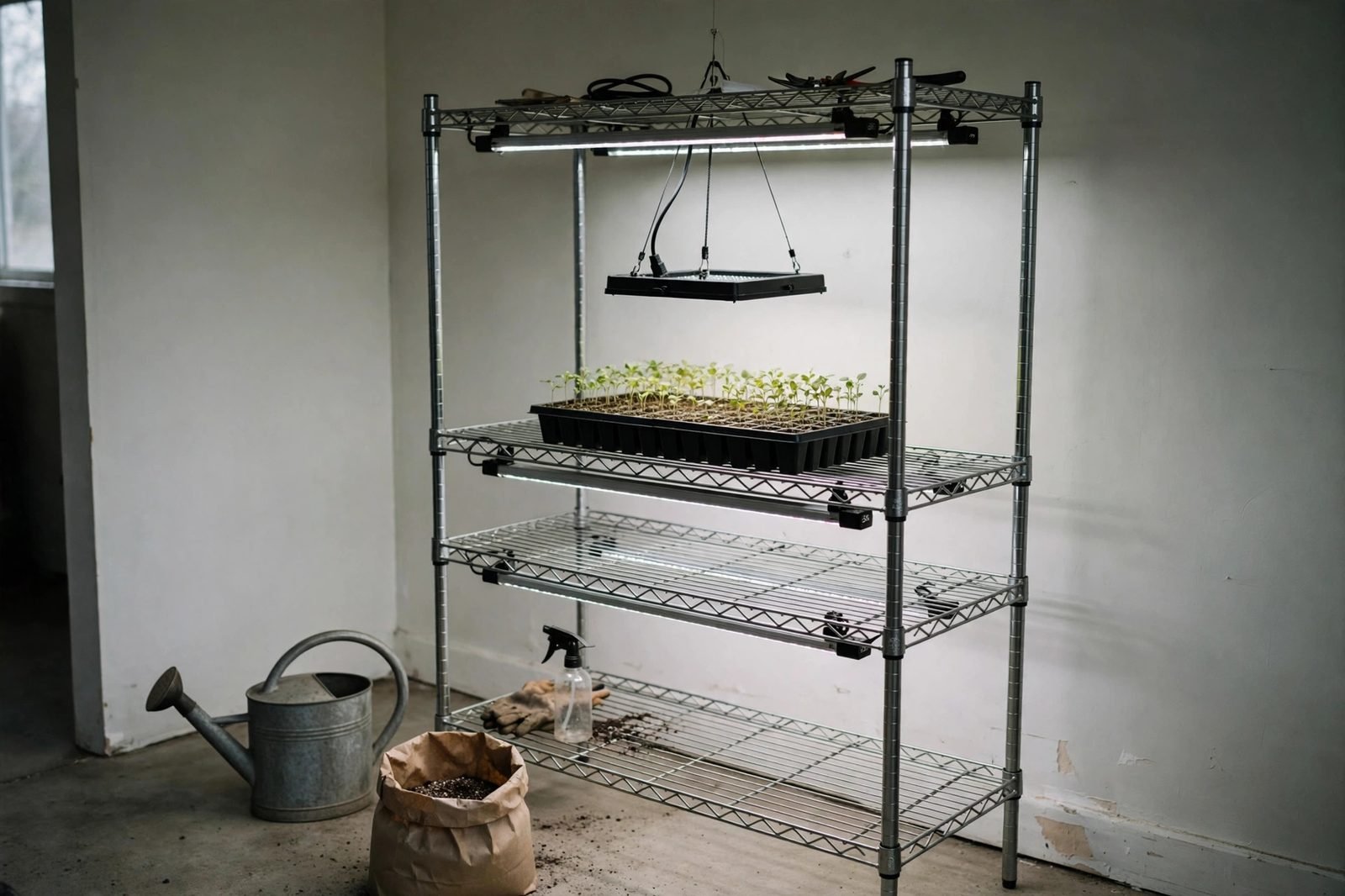
A wire shelf with four tiers can hold four trays of seedlings, and each tray needs a light. Two ways to hang that light cover most setups: bars clipped under the shelf above, or a light hung from cords that you can raise and lower. Both grow fine seedlings. They differ in how much room they need, how fast you can adjust them, and how many fixtures one shelf takes.
We have not tested either setup in our own garden, and this article makes no claim that we did. The numbers below are worked from stated assumptions about shelf size and coverage, plus extension guidance on distance and hours. For the setup steps behind this choice, see our guide on how to set up grow lights on a shelving unit.
Side by side: shelf-mounted vs hanging
| Feature | Shelf-mounted bars | Hanging light |
|---|---|---|
| How it hangs | Clipped or tied under the shelf above | Suspended from cords, chains, or ratchet hangers |
| Gap to plants | Fixed by the shelf spacing, about 6 to 8 inches | Adjustable from 4 inches to 2 feet or more |
| Fixtures per 2-by-4 shelf | Two bars, front and back | One light with a 2-by-4-foot footprint |
| Adjusting height | Move the shelf, or re-clip the bar | Pull the cord, no tools needed |
| Room needed above the tray | About 2 inches for the bar | About 6 to 12 inches of cord travel |
| Coverage | Even across the shelf when two bars are used | Even when the footprint matches the shelf |
| Best for | Fixed shelves with trays that stay put | Trays of mixed heights, or plants that grow fast |
| Weak spot | Hard to adjust as plants grow | Cords can tangle and swing if left loose |
The table assumes a standard 4-tier wire shelf with 2-by-4-foot shelves. Your shelf may differ, and the fixture counts shift with it. Measure your own shelf before you buy, and check the coverage footprint on the listing.
Shelf-mounted: fixed and close
A shelf-mounted bar clips under the shelf above the tray and stays there. The gap from bar to leaves is set by the space between your shelves, which is often 12 to 18 inches on a wire unit. Trays sit about 3 inches tall, so the leaves end up 6 to 8 inches below the bar when the tray is full. That gap sits near the 4 to 6 inches that University of Minnesota Extension lists for seedlings, and it works well for short crops like lettuce, herbs, and young transplants.

The strength of this setup is that nothing moves. Bars stay put, cords stay short, and the shelf looks tidy. You can run two bars per shelf, one toward the front edge and one toward the back edge, and the whole tray gets light with no dark strip down the middle. Zip ties or small clips hold each bar, and a plug timer on the shelf controls the hours.
The weak spot is adjustment. Seedlings grow an inch or two a week, and a fixed bar cannot follow them. You can raise the tray on a block or a flipped tray to close the gap, or lower the shelf above by a notch, and both take a few minutes per shelf. For a shelf of mixed heights, such as tall tomatoes beside short lettuce, a fixed bar leaves one crop too far from the light.
Hanging: adjustable height
A hanging light hangs from cords or a chain, and you set the gap by pulling the cord. Ratchet hangers make this a one-hand job: pull down to lower the light, press the tab to raise it. That matters when tomato seedlings grow two inches in a week and the gap you set on Monday is wrong by Friday.

Hanging suits plants that grow fast and trays that change height. You can hang one light over a tray of tall tomatoes at 8 inches, then lower it to 5 inches over a tray of fresh sprouts the next week. You can also hang the light higher for a few days to harden plants before they move outside, which is hard to do with a fixed bar.
The cost of that freedom is room and clutter. A hanging light needs 6 to 12 inches of cord above the tray for adjustment, so the shelf spacing must allow it. Cords can tangle when you move trays, and a light that swings can bump the shelf. Keep the cords short and tidy, and clip the slack to the shelf frame so it stays out of the way.
You can browse ratchet hangers for grow lights on Amazon to find the cord style that fits your shelf frame.
Our worked example: covering a 4-tier shelf
Here is the fixture math for a 4-tier wire shelf. We state every assumption so you can redo the math for your own shelf.
Assumptions: each shelf is 2 feet by 4 feet, which is 8 square feet, and the unit has 4 shelves, which is 32 square feet in total. A shelf-mounted bar is 4 feet long and lights a strip about 4 feet long and 1.5 feet wide, which is 6 square feet, so one bar leaves the front or back edge of a shelf dim. A hanging light has a footprint of 2 feet by 4 feet, which is 8 square feet, so one hanging light covers one full shelf. Each hanging light needs about 6 to 12 inches of cord travel above the tray, and each shelf-mounted bar needs about 2 inches of clearance below the shelf above.
Shelf-mounted count: 2 bars per shelf times 4 shelves is 8 bars in total. Each bar lights a 6-square-foot strip, and two bars side by side cover the full 8 square feet of a shelf with a small overlap down the middle.
Hanging count: 1 light per shelf times 4 shelves is 4 lights in total. Each light covers the full 8 square feet of its shelf, and the cord lets you set the gap anywhere from 4 inches to 2 feet.
Room check: a hanging setup needs 6 to 12 inches of cord travel per shelf, so a shelf spacing of 18 inches leaves about 6 inches for the tray and the plants after the cord takes its share. A shelf-mounted setup needs only 2 inches for the bar, so the same 18-inch spacing leaves about 13 inches for the tray and the plants. If your shelf spacing is tight, shelf-mounted bars fit more plant height. If your shelf spacing is generous, hanging lights give you adjustment room to spare.
Cost check: 8 bars at about $35 each in the typical budget range is about $280, while 4 hanging lights at about $60 each in a typical mid range is about $240. The hanging setup uses fewer fixtures here, and the shelf-mounted setup uses more, smaller fixtures. Your own prices will differ, and the fixture count matters more than the price of any one light. For stands that hold lights without a shelf at all, see our guide to the best grow light stands for seedlings.
Measuring the gap
Whatever you hang, the gap is what the plants feel. University of Minnesota Extension puts seedlings 4 to 6 inches from the light. Measure from the diodes to the top leaves with a tape, not by eye, and write the number on a label on the shelf so you can check it each week.
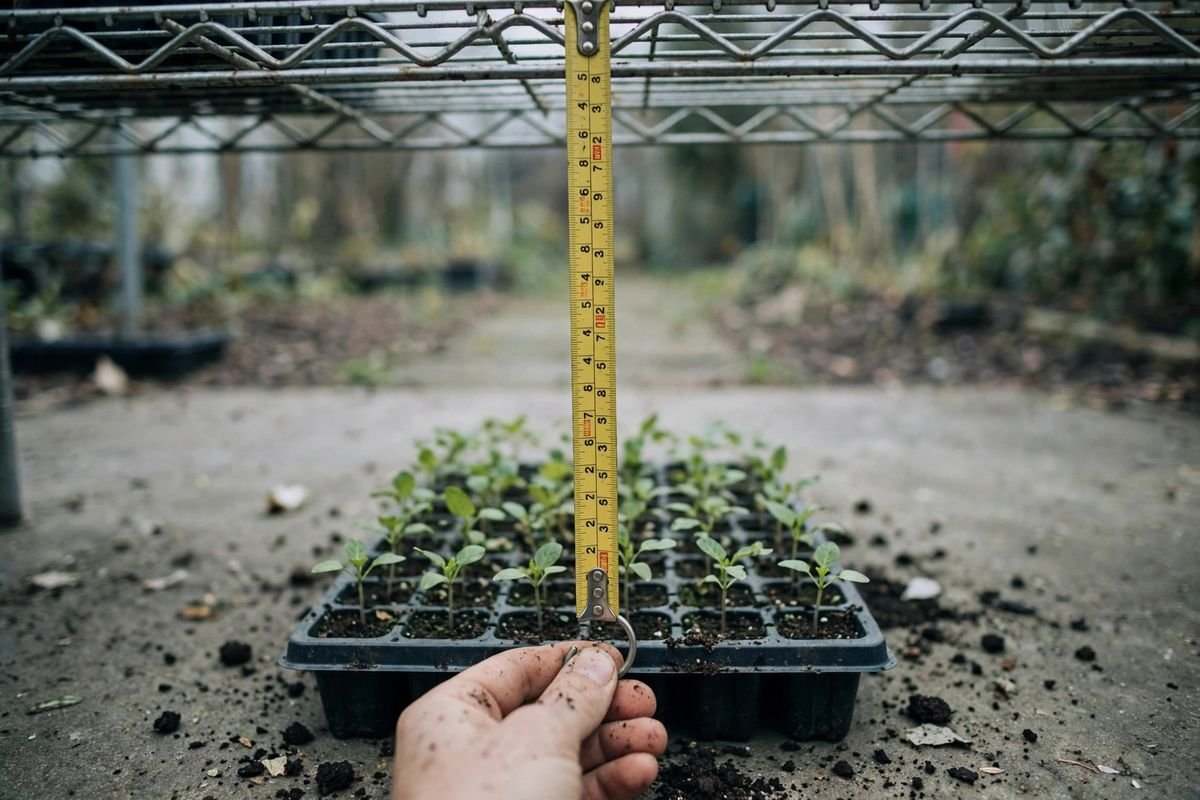
Check the gap each time you water. Seedlings grow fast, and a gap that was right on Monday can be two inches too wide by the next watering. With a hanging light, pull the cord and the gap is right again in seconds. With a shelf-mounted bar, slip a block under the tray or move the shelf a notch, and the gap is right again with a little more work.
Hours count beside the gap. University of Minnesota Extension lists 16 to 18 hours of light per day for seedlings. A plug timer holds that schedule for either setup, and it costs a few dollars. Set it once, and both setups run the same hours every day. For the height question in more depth, see our guide on how high grow lights should be above seedlings.
Shelf-mounted bars: pros and cons
Pros
- Nothing moves, so cords stay short and the shelf stays tidy.
- Needs only about 2 inches of clearance, so more room stays for the plants.
- Two bars per shelf give even light from front edge to back edge.
- Cheap per fixture, and easy to add one more bar where a shelf looks dim.
- Works well for short, even crops like lettuce, herbs, and young transplants.
Cons
- Hard to adjust as plants grow, since the gap is set by shelf spacing.
- Needs 8 bars for a 4-tier shelf in our worked example, which is more fixtures to buy and wire.
- Mixed heights on one shelf leave one crop too far from the light.
- Moving a shelf to change the gap takes minutes per shelf.
- A bar that is hard to reach is hard to clean, and dust cuts light.
Hanging lights: pros and cons
Pros
- Gap adjusts in seconds with a cord or ratchet hanger, so the light follows fast growth.
- Needs only 4 lights for a 4-tier shelf in our worked example, which is fewer fixtures.
- One light covers a full 2-by-4-foot shelf when its footprint matches.
- Easy to raise the light for hardening off before plants move outside.
- Suits trays of mixed heights on the same shelf.
Cons
- Needs 6 to 12 inches of cord travel, which eats shelf height.
- Cords can tangle and swing if left loose.
- Each light is heavier than a slim bar, so the shelf frame must hold the weight.
- A light that hangs crooked gives one side of the tray more light than the other.
- Costs more per fixture than a slim bar, even when fewer fixtures are needed.
Our verdict: choose the mount that fits your shelf and your crops
Choose shelf-mounted bars if your shelves are fixed, your trays stay put, and you grow short, even crops like lettuce and herbs. The setup is tidy, the gap stays close, and two bars per shelf cover the tray edge to edge.
Choose hanging lights if your plants grow fast, your trays hold mixed heights, and you want to change the gap in seconds. The cord travel costs shelf height, and the adjustment pays for it every week of the season.
Either mount fails when the gap drifts past 6 inches or the timer slips. Check the gap at every watering, and let the timer hold the hours. For the bar-versus-bulb question that often comes with this choice, see our guide on grow light bars vs bulbs.
Troubleshooting
Seedlings stretch toward one side
One side of the tray gets more light than the other. With a hanging light, check that it hangs level and centered over the tray. With bars, check that both bars run and that the tray sits centered under them. Turn the tray every day so each side takes a turn under the brightest spot.
The gap keeps growing
Seedlings grow an inch or two a week, and a fixed bar cannot follow. Slip a block under the tray, move the shelf a notch, or pull the hanging cord down a few inches. Check the gap at every watering so it never drifts far.
Cords tangle when trays move
Clip the slack to the shelf frame with a zip tie or a small hook, and leave only the length you need. A cord that hangs free catches on trays, and a cord clipped to the frame stays out of the way.
The top shelf gets all the light
Light from an upper shelf can spill onto the shelf below if the bars are wide or the shelves are open wire. Add a simple light shield, such as a sheet of cardboard on the shelf above the tray, or move light-hungry crops to the top and shade-tolerant crops below.
Frequently asked questions
How many lights does one shelf need?
It depends on the footprint of the light and the size of the shelf. In our worked example, a 2-by-4-foot shelf needs two 4-foot bars or one hanging light with a 2-by-4-foot footprint. Measure your shelf and check the footprint on the listing before you buy.
Can I mix shelf-mounted bars and hanging lights?
Yes. Many growers clip bars under the upper shelves and hang lights over the lower shelves where tall plants live. Keep the gap at 4 to 6 inches for seedlings on every shelf, whatever the mount.
How far above seedlings should the light hang?
University of Minnesota Extension lists 4 to 6 inches for seedlings, and you move the light up as the plants grow. Measure from the diodes to the top leaves, and check the gap each time you water.
When should I move seedlings outside?
Move them out after your last frost date, once you have hardened them off for a week in shade and wind. Use your local frost dates and regional planting guidance — not your USDA hardiness zone alone — to choose planting dates.
Sources and further reading
- University of Minnesota Extension, Lighting for indoor plants and starting seeds
- Michigan State University Extension, Selecting and starting seeds indoors
Related reading: How to Set Up Grow Lights on a Shelving Unit, Best Grow Light Stands for Seedlings, Grow Light Bars vs Bulbs, How High Should Grow Lights Be Above Seedlings