
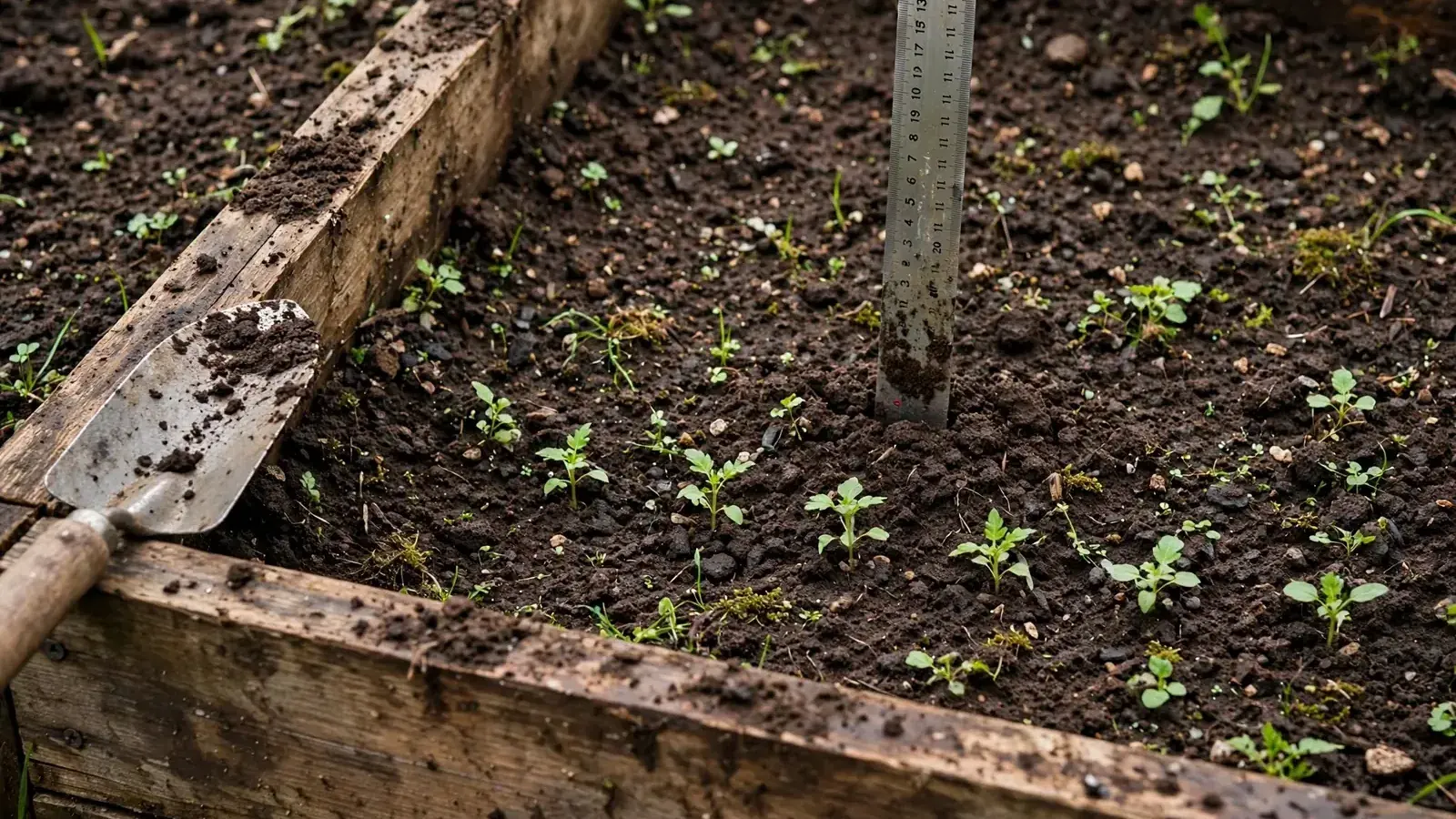
Ask five gardeners how deep a raised bed should be and you'll get five confident, different answers. Six inches is plenty. Twelve inches minimum. Deeper is always better. They're all right — for their own situations.
New to raised beds? Start with our Raised Bed Gardening Hub — every soil guide in one place.
There is no universal depth because depth isn't really about the bed. It's about three things: what you're growing, what's underneath, and how the bed drains. Get those three right and the depth picks itself.
Start With What You're Growing
Roots are the whole story. Different crops send roots to very different depths, and the soil only needs to be as deep as the roots that will live in it.
Shallow-rooted crops (6–8 inches is plenty): lettuce and salad greens, radishes, green onions, most herbs (basil, parsley, cilantro, chives), spinach.
Medium-rooted crops (8–12 inches): peppers, beans, cucumbers, eggplant, garlic, kale and most brassicas.
Deep-rooted crops (12 inches or more): tomatoes, carrots, parsnips, potatoes, sweet potatoes, winter squash.
This is why mixed beds usually land at 10–12 inches — that range covers nearly everything a home gardener grows. But if you're building a dedicated salad bed, there's no reason to pay for 12 inches of premium mix when 8 will do. Match the depth to the crop and you stop buying soil you don't need.
One caveat: these are typical ranges, not hard rules. A tomato will survive in 8 inches of soil; it just won't thrive the way it would with room to stretch. When in doubt, err deeper for fruiting crops and root vegetables, and save the shallow depths for greens and herbs.
What's Under the Bed Changes Everything
A raised bed is only as deep as its bottom allows. There are three common situations:
Open bottom on soil. The classic setup: a bottomless frame sitting directly on the ground. Roots can push past the frame into the earth below, so the "effective" depth is much greater than the frame height. An 8-inch frame on open soil grows carrots just fine — the roots don't stop at the wood.
Bottom on landscape fabric or hardware cloth. Common when gardeners want to block weeds or burrowing pests. Roots mostly stop at the barrier, so the frame depth is close to the true depth. If you're using a barrier, build a little deeper than you think you need.
Bed on a hard surface. Rooftop, patio, or driveway beds are closed containers. Every inch of root room has to come from the bed itself, and drainage has to be handled deliberately (more on that below). On hard surfaces, 12 inches is a sensible minimum for most vegetables, and deeper is genuinely better.
Drainage: The Hidden Depth Factor
Deeper soil doesn't just give roots room — it gives water somewhere to go. In a shallow bed, there's less soil to absorb a heavy rain or an enthusiastic watering session, so water can pool at the bottom or run off the top.
This matters most in two situations:
- Heavy native soil underneath. If your bed sits on clay, water draining out of the bed hits a slow-draining layer and can back up. Extra depth in the bed gives excess water more room before it becomes a problem.
- Frequent watering. Containers and shallow beds dry out fast, which tempts gardeners to water often. Deeper soil holds a larger reservoir, so moisture levels stay more even between waterings.
That said, depth alone doesn't fix bad drainage. If water has nowhere to exit — a bed on concrete with no drainage holes, for example — a deeper bed just holds a deeper puddle. Drainage always comes first; depth is the backup.
The Case for Going Deeper Than the Minimum
Even when 8 inches would technically work, there are good reasons many gardeners default to 10–12:
- Soil life needs room. The microbial activity that makes soil fertile happens throughout the profile, not just at the surface. More soil volume means a more stable, forgiving ecosystem.
- Less frequent watering. Deeper soil buffers moisture swings, which matters in hot climates and for anyone who can't water daily.
- Flexibility. A 12-inch bed grows shallow crops today and tomatoes next year. A 6-inch bed locks you into greens and herbs.
- Settling. Beds lose an inch or two to settling in the first season. Starting deeper means you still have adequate depth after everything compacts.
The trade-off is cost. Soil is the most expensive part of a new bed, and every extra inch across a 4×8 footprint is real money. That's the genuine tension: depth buys forgiveness, but you pay for it by the cubic foot.
When Shallow Is the Smart Choice
Deeper isn't always better. Shallow beds make sense when:
- You're growing only greens and herbs. A dedicated salad bed at 6–8 inches is cheaper to fill and easier to reach into.
- The bed sits on good soil. With an open bottom over decent ground, a short frame is really just a tidy border — roots do the rest.
- Budget is tight. Filling a 12-inch bed costs roughly twice what a 6-inch bed costs. Starting shallow and adding a second frame layer later is a legitimate strategy.
- Accessibility matters. Lower beds are easier to reach across and work from a seated position.
Putting It Together
Here's a practical way to decide:
1. List what you'll grow in the bed this year and next.
2. Find the deepest-rooted crop on the list.
3. Check what's under the bed — open soil gives you bonus depth, barriers and hard surfaces don't.
4. Pick the frame depth that covers the deepest roots, erring upward if the budget allows.
For most mixed vegetable beds, that lands at 10–12 inches. For a herbs-and-salad bed on open soil, 6–8 inches is honest and economical. Either way, calculate your raised-bed soil volume before you shop — depth decided, math handled. If you want the full volume walkthrough first, our guide to how much soil a raised bed needs covers the formula step by step.
Once you've settled on a depth, calculate your raised-bed soil volume to find out exactly how much mix to buy — the calculator handles the math, the bag counts, and a settling buffer.
Frequently Asked Questions
Is 6 inches deep enough for a raised bed?
For lettuce, herbs, radishes, and green onions — yes, especially over open soil. For tomatoes, peppers, or carrots, no.
Can a raised bed be too deep?
Practically speaking, no — but past about 18 inches you’re paying for soil with diminishing returns for most vegetables. Very deep beds also need a plan for filling the bottom economically.
Do I need to replace the soil every year?
No. Top up what settles (usually an inch or two of compost each spring) and the bed improves with age as organic matter builds.
Does bed depth affect watering?
Yes. Shallow beds dry out faster and need more frequent watering; deeper beds hold moisture longer and forgive a missed day.
Don’t guess — calculate it. Enter your bed’s length, width, and depth in our free Raised Bed Soil Calculator for exact cubic feet, bag counts, and bulk cubic yards — with a settling buffer built in.