
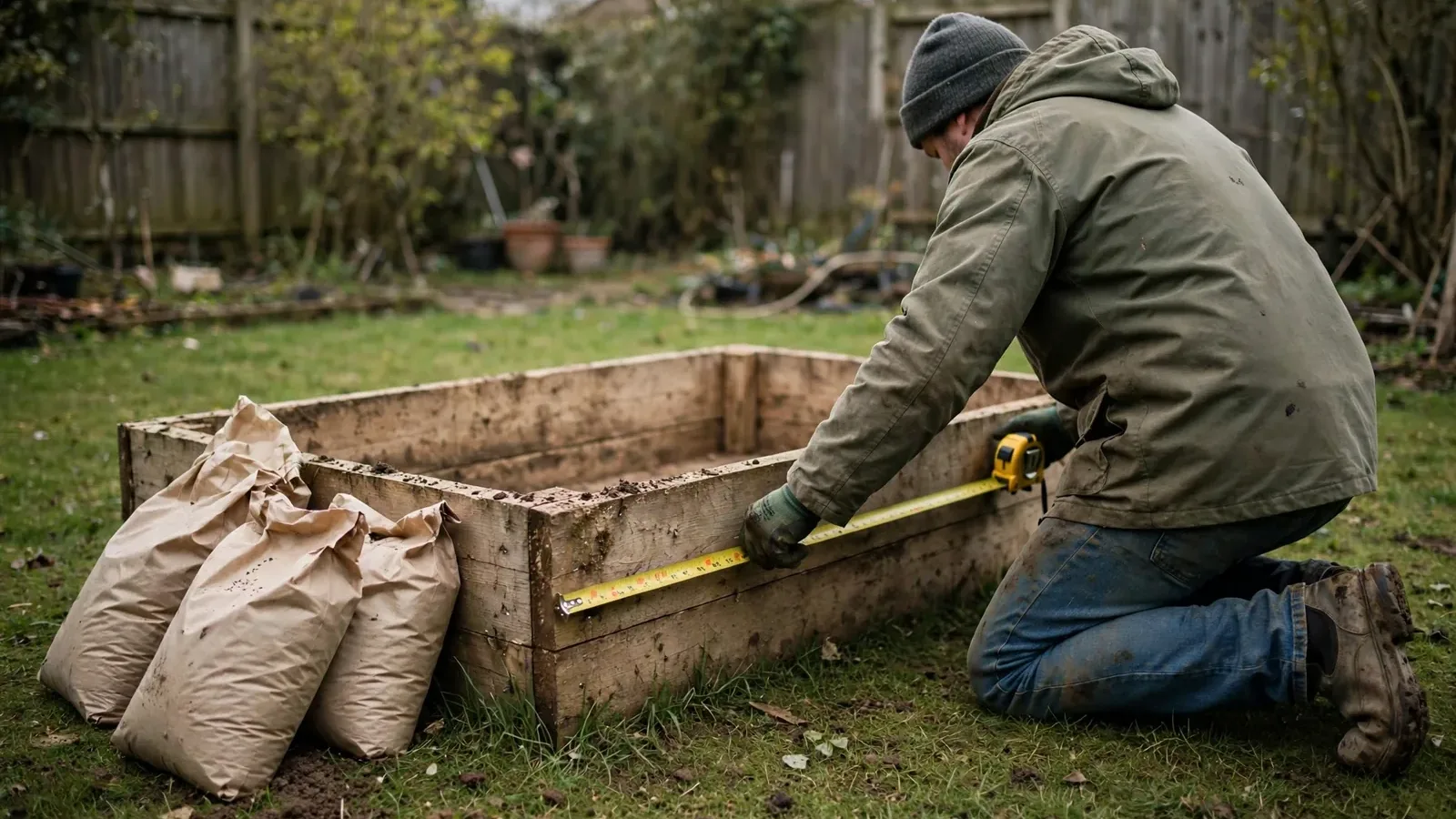
If you've ever stood in the garden center aisle staring at a wall of soil bags, doing shaky mental math, you're not alone. Ordering too little means a second trip (or a half-filled bed). Ordering too much means bags of expensive mix sitting in your driveway all summer.
New to raised beds? Start with our Raised Bed Gardening Hub — every soil guide in one place.
The good news: this is one of the simplest calculations in gardening. Once you know your bed's dimensions and how deep you want the soil, the answer is just multiplication.
The Simple Volume Formula
A raised bed is basically a box. The soil volume it holds is:
Length × Width × Depth = soil volume
Do all three measurements in feet, and your answer comes out in cubic feet — which is exactly the unit soil is sold in.
The only wrinkle: bed depth is usually talked about in inches. Convert it first:
Depth in feet = depth in inches ÷ 12
So a bed that's 12 inches deep gets a depth value of 1 foot. A bed that's 8 inches deep is 0.67 feet (8 ÷ 12).
That's the whole formula. Everything else — bags, cubic yards, bulk orders — is just unit conversion on top of this number.
Worked Examples
Let's run the three most common bed sizes, all filled 12 inches deep:
4×4 bed, 12 inches deep 4 × 4 × 1 = 16 cubic feet
4×8 bed, 12 inches deep 4 × 8 × 1 = 32 cubic feet
2×8 bed, 12 inches deep 2 × 8 × 1 = 16 cubic feet
Notice the 4×4 and the 2×8 need exactly the same amount — they have the same footprint area (16 square feet). That's a handy shortcut: beds with equal floor area and equal depth always need equal soil.
Drop the depth to 8 inches and each of these numbers shrinks by a third. A 4×8 at 8 inches deep needs about 21 cubic feet instead of 32. Depth is the lever that moves the total most, which is why it's worth thinking about before you buy.
Why Depth Matters More Than You'd Think
Most beginners pick a bed size first and treat depth as an afterthought. But depth is what decides both your soil bill and what you can grow.
Shallow-rooted crops like lettuce, radishes, and most herbs are perfectly happy with 6 to 8 inches of good soil. Deep-rooted crops — tomatoes, carrots, parsnips — want 12 inches or more to stretch out. If you know what you're planting, you can match the depth to the crop instead of defaulting to a full 12 inches and paying for soil you don't need.
There's also what's under the bed. A bottomless bed sitting on open soil effectively has unlimited depth below it — roots can push past the frame into the ground. A bed on concrete or lined with landscape fabric is a closed container, and every inch of depth has to come from what you put in. (More on choosing depth in our guide to how deep raised bed soil should be.)
From Cubic Feet to Bags
Soil bags are labeled by volume, most commonly 1, 1.5, or 2 cubic feet. To get your bag count:
Total cubic feet ÷ bag size, rounded up
A 4×8 bed at 12 inches deep (32 cubic feet) works out to:
- 32 bags of 1 cu ft soil
- 22 bags of 1.5 cu ft soil (21.3 rounds up)
- 16 bags of 2 cu ft soil
Always round up. A bed that's 97% full looks unfinished, and the leftover half-bag always finds a use — topping up a container, filling a low spot, refreshing last year's bed.
If you're ordering in bulk instead of bags, divide cubic feet by 27 to get cubic yards. That same 4×8 bed needs about 1.19 cubic yards. Most bulk suppliers sell by the cubic yard (or half yard), so you'd order roughly a yard and a quarter.
Don't Forget Settling
Freshly filled soil settles. Between watering, gravity, and the natural breakdown of organic matter, a bed filled level to the top in spring can sit an inch or two lower by midsummer. This is normal, not a sign you did something wrong.
The practical fix is a small buffer: add about 5–10% to your calculated volume. For that 32-cubic-foot 4×8 bed, 10% is just over 3 extra cubic feet — roughly two more 1.5 cu ft bags. It's cheap insurance against a second trip to the store.
If you want to skip the mental math, our Raised Bed Soil Calculator handles the volume, the bag counts, and the settling buffer for any bed size — just enter your dimensions and depth.
What If You're Not Filling It All the Way?
Not every bed gets filled to the brim with premium mix, and that's fine. Common approaches:
- Leaving headroom. Many gardeners fill to an inch or two below the rim so water doesn't wash soil over the edge. Just subtract that freeboard from your depth in the formula.
- Bottom fillers. Logs, branches, straw, and leaves in the bottom third of a deep bed (the hugelkultur-inspired approach) reduce the soil you need to buy. They break down slowly over a few seasons. Just know the bed will settle more as they decompose, so plan on topping up.
- Layering over existing soil. If your bed sits on decent ground, some gardeners fill only the top 6–8 inches with quality mix and let roots reach the native soil below.
Whatever approach you take, the formula still works — you're just plugging in the depth of the layer you're actually buying soil for.
How many bags of soil does a 4×8 raised bed need?
At 12 inches deep, about 16 bags of 2 cu ft soil, 22 bags of 1.5 cu ft, or 32 bags of 1 cu ft — plus a small buffer for settling.
Does compost count toward the total soil volume?
Yes. Whatever goes into the bed — topsoil, compost, bagged mix — takes up space and counts toward the total. The formula doesnu0026#x27;t care what the material is, only how much space it fills.
How often does raised bed soil need topping up?
Most beds settle an inch or two per year. A yearly top-dress of an inch of compost in spring is standard practice for established beds.
Should I just buy extra to be safe?
A 5–10% buffer is reasonable. Much more than that and youu0026#x27;re storing bags. Soil doesnu0026#x27;t go bad, but opened bags dry out and unopened bags are heavy to move twice.
The Bottom Line
Measure your bed, pick your depth, multiply. Length × width × depth (in feet) gives you cubic feet, and everything else follows from there. Run the numbers before you shop, add a small buffer for settling, and you'll fill the bed once — no second trip required.
Ready to plug in your own dimensions? Estimate how much soil your bed needs with our free calculator.
Sources
- Colorado State University Extension — Maximum Rooting Depth (MRD) values by crop, aggregated from UC Davis, FAO, and NRCS references: extension.colostate.edu/docs/pubs/crops/05623.pdf
- University of Minnesota Extension — recommended compost application rates for garden beds: extension.umn.edu
Don’t guess — calculate it. Enter your bed’s length, width, and depth in our free Raised Bed Soil Calculator for exact cubic feet, bag counts, and bulk cubic yards — with a settling buffer built in.