
This post may contain affiliate links. If you buy through links on this page, we may earn a commission at no extra cost to you.
As an Amazon Associate I earn from qualifying purchases.
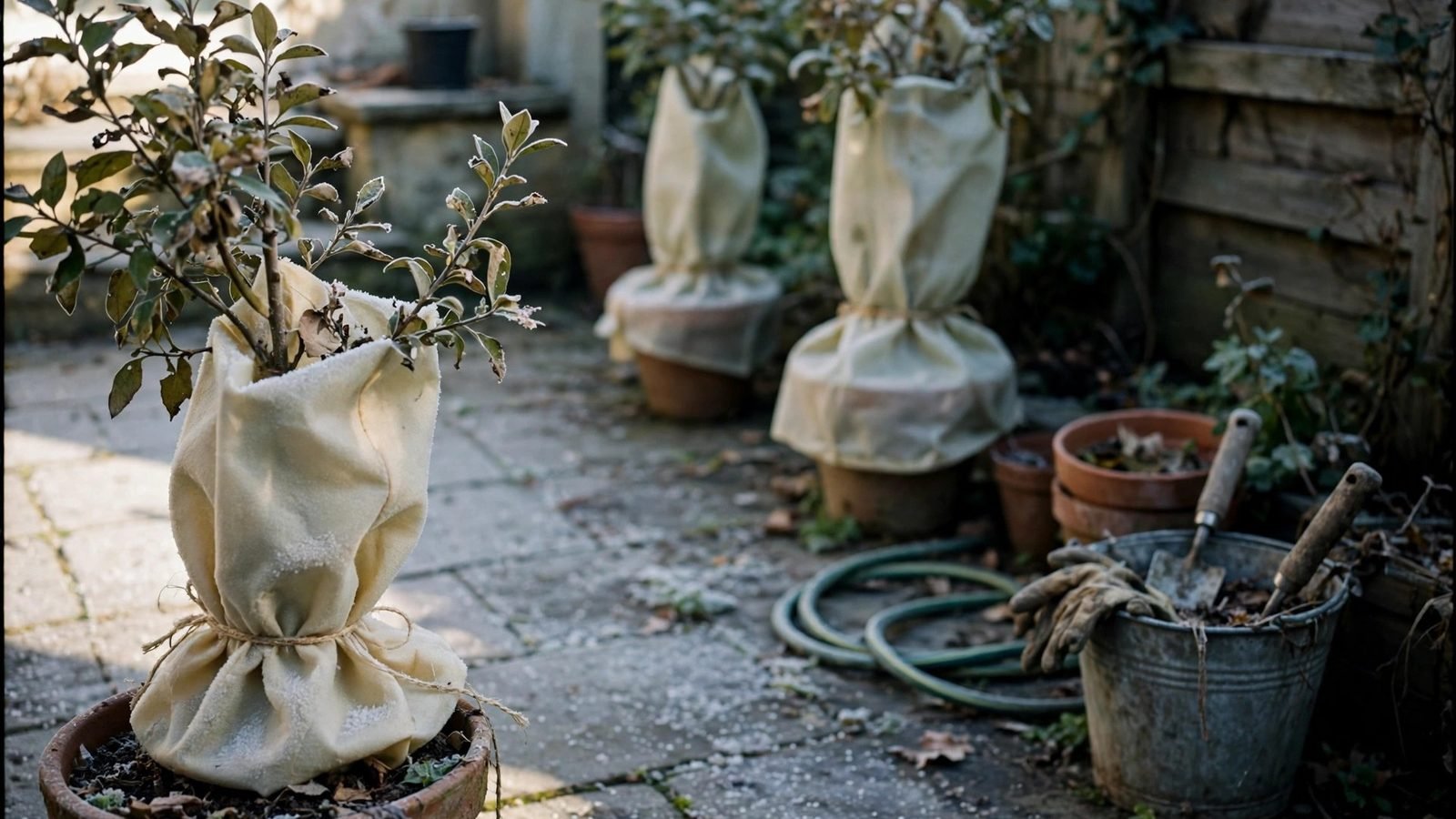
A potted tree is more exposed to frost than the same tree planted in the ground. The roots sit in a pot above the soil, cold air reaches them from every side, and a hard freeze can damage roots that would have been safe underground. A frost cover holds the warmth the pot and soil gathered during the day, keeps cold wind off the leaves, and can carry a tree through a cold night that would otherwise damage it.
This is a research-based shortlist, not a hands-on test. The picks below come from the cover types, sizes, and tradeoffs that growers keep recommending, and from what the listings themselves describe. No cover here has been tested in our own garden, and prices and exact specs change, so check the listing before you buy.
Use your local frost dates and regional planting guidance — not your USDA hardiness zone alone — to choose planting dates. The same dates tell you when covers need to be ready: the average last frost date is the anchor, and the forecast for the next two weeks is the check before a cold night.
Quick comparison
The table below sums up the five picks. The sections after it give the tradeoff for each one, so you can match the cover to the tree you own.
| Pick | Style | Best for |
|---|---|---|
| Drawstring frost bag | Bag with drawstring base | Most potted trees, most nights |
| Zippered tree cover | Bag with side zipper | Tall trees you cover often |
| Frost blanket for pots | Flat fabric sheet | Short trees and shrubs in pots |
| Burlap wrap | Roll of woven fabric | Trunks and evergreens |
| Insulated pot wrap | Wrap for the pot only | Protecting roots on hard nights |
Measure the tree before you buy anything. A cover that is too small will not close at the base, and cold air will pour in through the gap. A cover that is far too large will flap in the wind and press against the leaves, which is where frost damage starts.
How to choose a frost cover for a potted tree
Start with the height and the width of the canopy. Measure the tree from the soil line to the top of the highest branch, then measure the canopy at its widest point. The cover needs to be taller than the tree, wider than the canopy, and long enough to reach the ground or the pot rim with slack to tie off.
Next, look at how the cover closes. A drawstring at the base pulls the cover tight around the pot, which keeps cold air out and holds the cover on in wind. A zipper down the side makes the cover easy to put on and take off a tall tree, but a zipper is also a seam where cold air can leak in, so check that it closes fully and has a storm flap over it.
Check the fabric weight as well. Light frost fabric, about 1 to 2 ounces per square yard, protects against a light frost down to about 28 degrees. Heavier fabric, about 3 ounces per square yard, protects further, into the low 20s, but it blocks more light and should not stay on during the day. The listing usually states the fabric weight and the temperature it is rated for: treat the rating as a guide, not a promise, since wind and damp soil change the result.
Our guide to protecting potted fig trees in winter covers the same covering routine for one of the most frost-tender potted trees, and our guide to overwintering lemon trees in pots covers the full winter routine for citrus.
Worked example: what size cover a tree needs
Buying a cover that is too small is the most common mistake, and it is easy to avoid with a tape measure. This example works out the size for one common potted tree, using stated inputs, so you can repeat the steps for your own trees.
Take a potted lemon tree 4 feet tall from the soil line, with a canopy 3 feet across at its widest point. The cover has to be taller than the tree, so allow 6 inches of slack above the top: 4 feet plus 6 inches gives 4.5 feet of height. The cover also has to reach the pot rim with slack to tie off, so add another 6 inches at the bottom: 4.5 feet plus 6 inches gives 5 feet of total length.
For the width, the cover has to clear the canopy with room to spare, so allow 6 inches of slack on each side of the 3-foot canopy: 3 feet plus 1 foot gives a 4-foot diameter. A round cover 5 feet long and 4 feet across fits the tree with slack at the top, the sides, and the base.
Check the listing size against those numbers before you buy. A cover sold as 4 by 6 feet would fit this tree, while a cover sold as 3 by 4 feet would not close at the base, and the tree would freeze from the bottom up.
1. Drawstring frost bag
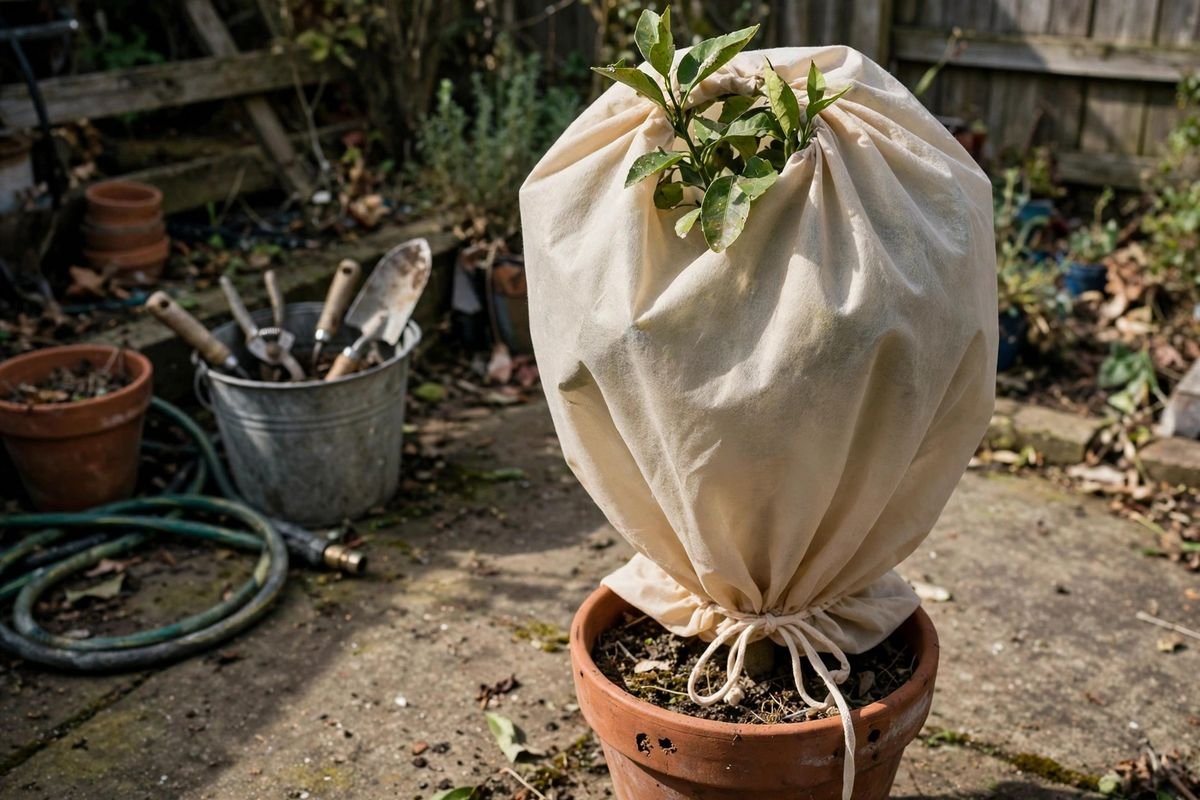
The drawstring bag is the simplest pick: a bag of frost fabric, closed at the top, with a drawstring at the base. Pull it over the tree from the top, gather the bottom around the pot, and pull the string tight. It is the pick most growers reach for first, because it fits most trees and it stays on in wind.
Pros: easy to put on and take off; the drawstring seals the base against cold air; light enough to leave on for several nights in a row; folds small for storage.
Cons: a tight drawstring can rub the bark if it is pulled too hard; the bag presses against the outer leaves, and leaves that touch the fabric can freeze faster than leaves with an air gap; no zipper, so a tall tree needs a step stool to get the bag over the top.
Choose this one if you cover one or two potted trees on occasional cold nights, and you want the simplest cover that works. It is the best pick for most potted trees.
Search for a frost protection cover for potted trees and match the listed size to the height and canopy width you measured.
2. Zippered tree cover
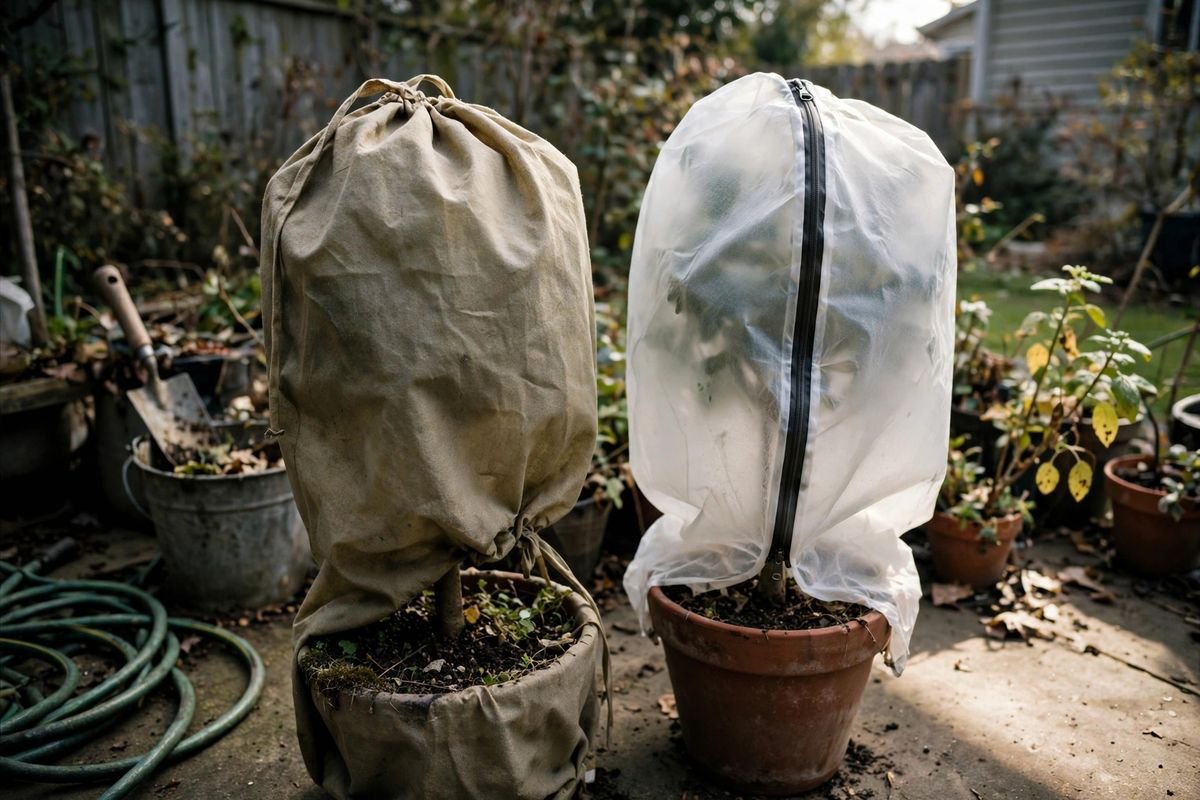
A zippered cover is a bag with a zipper down one side. You open the zipper, wrap the cover around the tree, and zip it shut, instead of lifting a bag over the top. It is the pick for tall trees you cover often, and for trees with stiff branches that snag a bag pulled from above.
Pros: easy to put on a tall tree without a ladder; the zipper lets you open the cover on a warm day without taking it off; fits trees with wide, stiff branches.
Cons: costs more than a drawstring bag; the zipper can snag on the fabric; a zipper that does not close fully leaks cold air along the seam.
Choose this one if you cover the same tall tree many nights each winter, or if the tree is too tall to lift a bag over. Check that the zipper runs the full length of the cover and has a flap over it before you buy.
Search for a zippered frost cover for trees and check the zipper length and the fabric weight on the listing.
3. Frost blanket for pots
A frost blanket is a flat sheet of frost fabric, not a bag. Drape it over a short tree or shrub, let the edges hang to the ground, and weight them down with stones or bricks. It is the pick for short trees, shrubs, and groups of small pots that fit under one sheet.
Pros: covers several small pots at once; cheap for the area it covers; easy to fold and store; no size matching beyond the sheet size.
Cons: the edges can lift in wind if they are not weighted well; the fabric touches the leaves wherever it rests on them; hard to seal around a single tall tree.
Choose this one if you have several short potted shrubs or a row of small pots, and you want one cover for the whole group. It is also the best pick for a low, wide tree that would need a very large bag.
Search for a plant frost blanket in a size that covers the pots with at least a foot of overhang on each side to weight down.
4. Burlap wrap
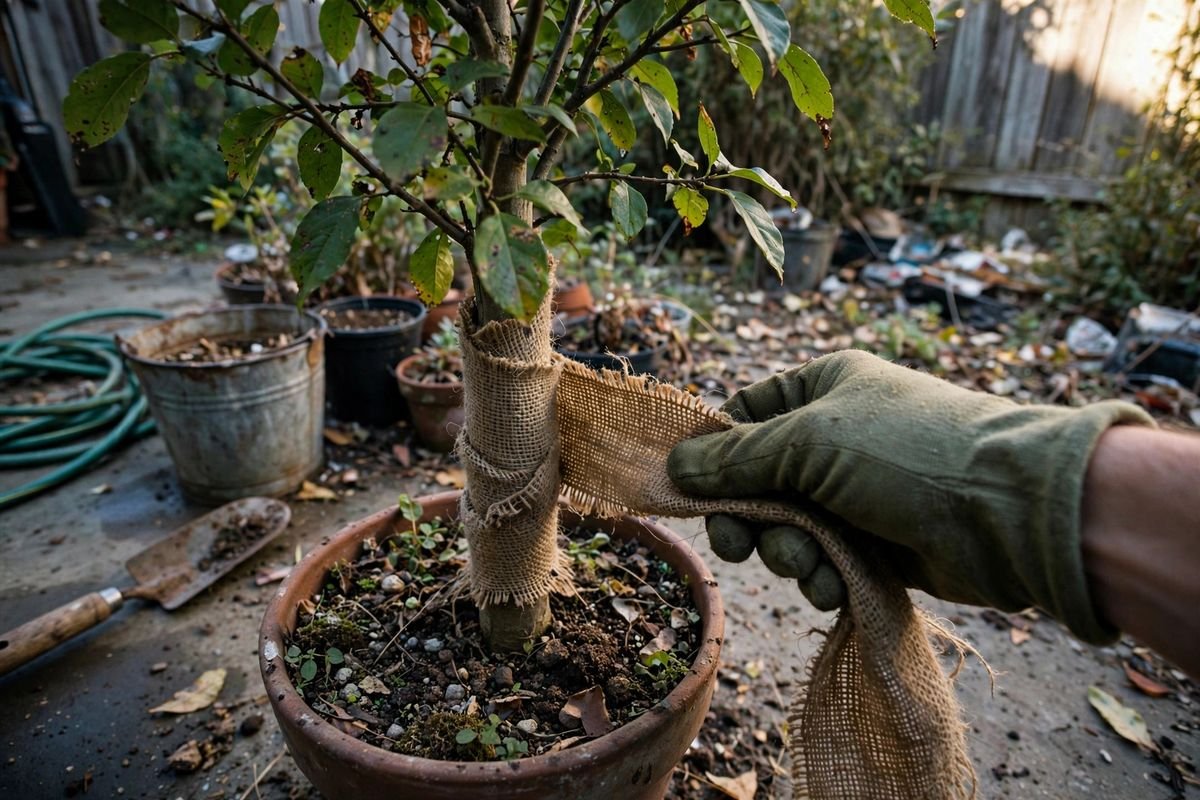
Burlap is a roll of woven jute fabric, wrapped around the trunk and branches in a spiral and tied off. It is the pick for evergreens and for trees whose trunks need protection from sunscald and wind, as well as frost. It breathes, so moisture does not build up under it, and it lasts for years if it is stored dry.
Pros: breathable, so it does not trap damp air; protects the trunk from wind and winter sun; cheap by the roll; easy to cut to any length.
Cons: takes time to wrap properly; does not cover the canopy as fully as a bag; gaps between the wraps let cold air through if the spiral is loose.
Choose this one if the tree is an evergreen, or if the trunk and lower branches are the parts at risk rather than the whole canopy. Wrap from the bottom up, overlap each turn by half the width, and tie the top off so the wrap does not slide down.
Search for burlap rolls for trees and check the roll width: a 3-foot-wide roll covers a trunk in fewer turns than a narrow one.
5. Insulated pot wrap
An insulated pot wrap covers the pot, not the tree. It is a sleeve of bubble wrap, foam, or burlap that goes around the outside of the pot and ties off at the rim. It is the pick for hard nights, when the roots are at more risk than the leaves, and it works best paired with a cover over the top.
Pros: protects the roots, which are the most exposed part of a potted tree; cheap; works with any cover over the top; can stay on all winter.
Cons: does nothing for the leaves and branches; a wrap that holds water against the pot can crack a clay pot when it freezes; needs a cover over the top for full protection.
Choose this one if your winters are cold enough to freeze the root ball, or if the tree is hardy above ground but the pot is small. Wrap the pot before the first hard freeze, and leave the wrap on until spring.
Our guide to protecting clay pots from freezing covers why clay pots crack in a freeze and how a wrap stops it.
Using a frost cover the right way
Put the cover on in the late afternoon, while the pot and soil are still warm from the day. A cover put on after dark traps cold air, not warm air, and does little good. Water the pot in the afternoon as well, since damp soil holds heat better than dry soil, and the cover holds that warmth in through the night.
Take the cover off in the morning, once the temperature has risen above freezing. A cover left on through a sunny day can heat the tree up fast and dry the leaves out, and a cover left on for days in a row holds moisture against the leaves, which invites mold.
Never let the cover touch the leaves if you can avoid it. Where fabric touches a leaf, the leaf loses heat to the cold fabric and freezes faster than a leaf with an air gap. A frame of stakes, a tomato cage, or a few sticks pushed into the pot holds the cover off the leaves and makes a real difference on a hard night.
Our comparison of frost cloth vs. plastic cover covers which material to reach for on a cold night, and our guide to frost covers for raised beds and containers covers larger beds that need the same treatment.
Frequently asked questions
How cold can a covered potted tree handle?
It depends on the tree and the cover. A light frost fabric cover typically holds the air inside 4 to 8 degrees warmer than the air outside, so a tree that is damaged at 28 degrees may survive a night at 24 degrees under cover. A hardy tree in a large pot handles far more cold than a tender tree in a small pot, since the larger pot holds more heat.
Should the cover reach the ground?
Yes, if the tree sits on the ground. A cover that reaches the ground traps the warmth rising from the soil, which is the main heat source on a cold night. A cover that stops at the pot rim leaves the roots exposed to cold air from below. For a tree on a raised deck, tie the cover around the pot instead.
Can I leave a frost cover on for a week?
A breathable fabric cover can stay on for several nights in a row during a cold spell, but take it off on mild, sunny days so the tree gets light and air. A cover left on for a week straight holds moisture against the leaves and can invite mold, especially on evergreens.
Do I need to cover the pot as well as the tree?
On a light frost night, a cover over the top is usually enough. On a hard freeze, wrap the pot as well, since the roots in a pot freeze faster than roots in the ground. Move the pot against a house wall first if you can: the wall gives off heat and blocks the wind, and the cover does the rest.
Sources and further reading
- University of Minnesota Extension: Extending the Growing Season
- Royal Horticultural Society: Greenhouses, Heating Efficiently
Related reading: How to Protect Potted Fig Trees in Winter, How to Overwinter Lemon Trees in Pots, How to Protect Raised Beds from Frost, Best Frost Covers for Raised Beds and Containers
By the Pot and Plot Team