
This post may contain affiliate links. If you buy through links on this page, we may earn a commission at no extra cost to you.
As an Amazon Associate I earn from qualifying purchases.
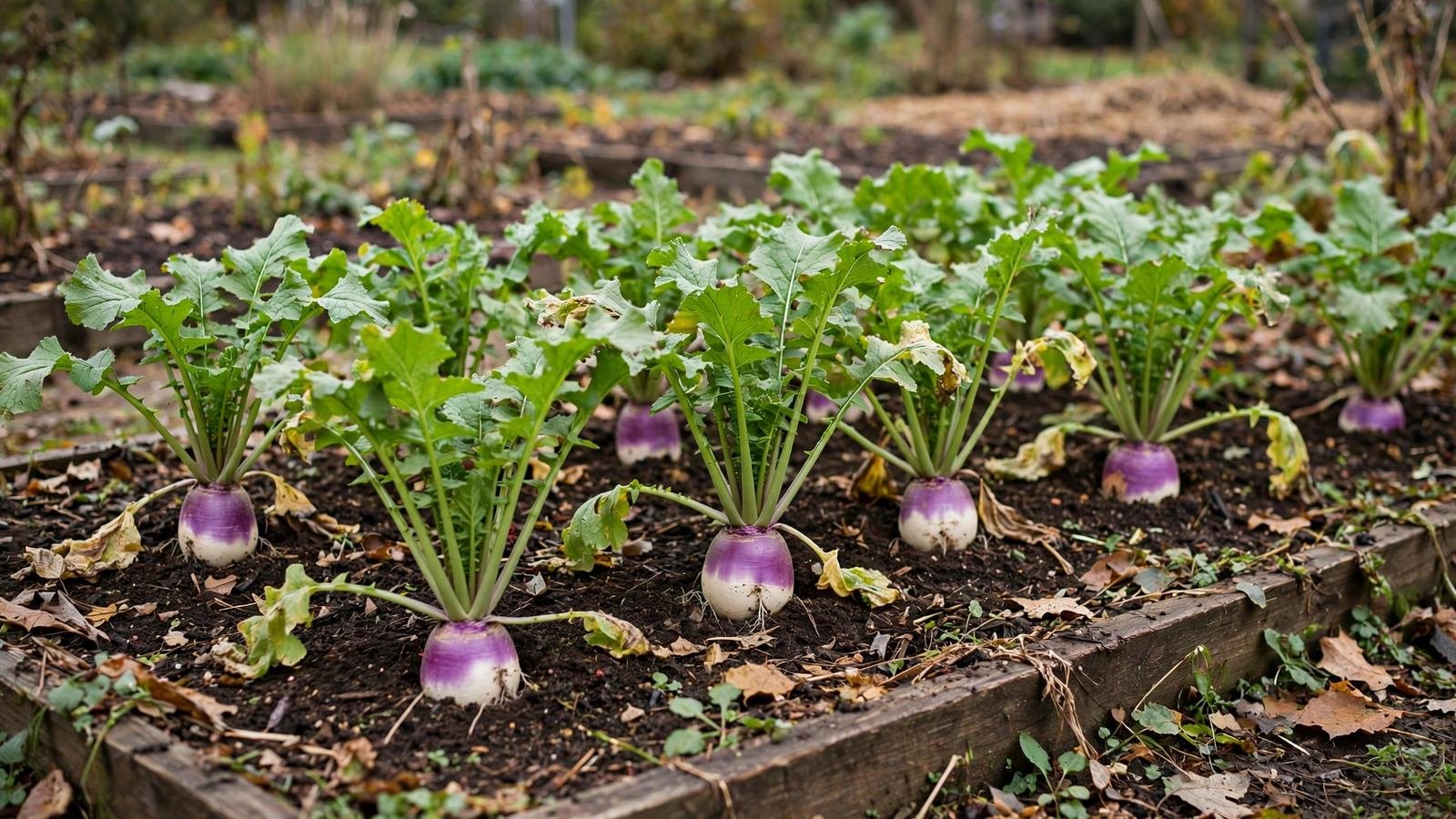
Turnips have an image problem. Mention them to most gardeners and you’ll get a wrinkled nose and a story about some woody, bitter monster pulled from a summer garden. That reputation is almost always earned the hard way: turnips sown in spring heat, left in the ground too long, and harvested at the size of softballs. Of course they tasted terrible.
Fall-grown turnips are a completely different vegetable. Sown in late summer and harvested in cool weather, they’re crisp, mild, and faintly sweet — closer to a radish’s texture with none of the bite. They’re also one of the fastest crops you can plant: some varieties go from seed to harvest in about a month, which makes turnips the perfect confidence-builder for a first fall garden.
The difference between great turnips and disappointing ones comes down to three things — sowing at the right time, thinning properly, and harvesting at the right size. None of it is complicated, and all of it is covered below.
In this guide, you’ll learn when to plant turnips based on your first frost date, the step-by-step sowing process, how to thin for crisp roots instead of crowded greens, fall care basics, the best varieties for autumn, exactly when to pull (the golf-ball-to-tennis-ball rule), how to harvest the greens — plus troubleshooting and answers to the questions every turnip grower asks.
Quick Care Overview
| Care item | Details |
|---|---|
| Botanical name | Brassica rapa |
| Days to germination | 4–7 |
| Days to maturity | 30–60, depending on variety |
| Sow depth | ¼–½ inch |
| Spacing | Thin to 3–4 inches apart for roots (2 inches for greens); rows 12–18 inches apart |
| Soil temperature for germination | 60–85°F; best around 70°F |
| Light | Full sun (6+ hours) |
| Soil | Loose, well-drained, pH 6.0–7.5 |
| Water | About 1 inch per week; keep soil evenly moist |
| Fertilizer | Light feeders; usually fine without added fertilizer |
| Harvest size | Roots 1½–2½ inches across (golf-ball to tennis-ball) |
Why grow turnips in fall
Turnips aren’t just a fall option — fall is when they shine. Here’s the case for giving them a row:
- Speed. At 30–60 days to maturity, turnips are among the fastest fall crops. Sow in August and you’re eating them in September or October — instant gratification by vegetable-garden standards.
- Cold sweetens them. Like most root crops, turnips convert starches to sugars as nights cool. A fall turnip is milder and sweeter than the same variety grown in spring heat.
- Two crops in one. The peppery greens are a Southern staple in their own right, and you can harvest them for weeks before — and alongside — the roots.
- Forgiving for beginners. Turnip seed is cheap, germination is fast and reliable, and the plants are tough. If a fall experiment fails, you’ve lost a packet of seed, not a season.
- Great storage crop. Fall roots keep for weeks in the refrigerator, so a modest row carries you well past the first frosts.
Turnips in brief
Turnips (Brassica rapa) belong to the mustard family, alongside radishes, bok choy, and broccoli. They’re cool-season biennials grown as annuals — in the vegetable garden, you harvest the swollen root (technically a swollen stem base, for the botanically curious) in the first year.
One thing worth knowing up front: turnips are sensitive to heat. Sown in warm spring soil they bolt, turn spicy, and get woody fast. Sown in cooling late-summer soil they do the opposite — they grow steadily, stay mild, and size up beautifully. Timing isn’t a minor detail with this crop; it’s most of the battle.
When to plant turnips in fall
Count back 6–10 weeks from your average first fall frost date and sow in that window. Because turnips mature so quickly — 30 days for the fastest salad types, up to 60 for storage varieties — the timing is more forgiving than with slower fall crops. If your first frost arrives in October, that usually means sowing from late July through August; where frost holds off until November or later, you can sow into September and sometimes October.
Turnip seed germinates best in soil between 60 and 85°F, with the happiest germination around 70°F. Late-summer soil is often still warm, so a quick check with a soil thermometer before sowing saves you from a failed stand. If the soil is still above 85°F, wait a week or sow in the cooler part of the day and water the row well — moisture drops soil temperature noticeably.
Sow every two to three weeks until about a month before your first frost, and you’ll have a continuous supply instead of a single wave. If you’re planning the whole autumn garden, what to plant in October covers turnips alongside the other fast fall crops worth squeezing in.
How to plant turnips: step by step
Turnips are always direct-sown. The seed is tiny, germination is quick, and the plants dislike transplanting — sowing in place is easier and works better. Here’s how:
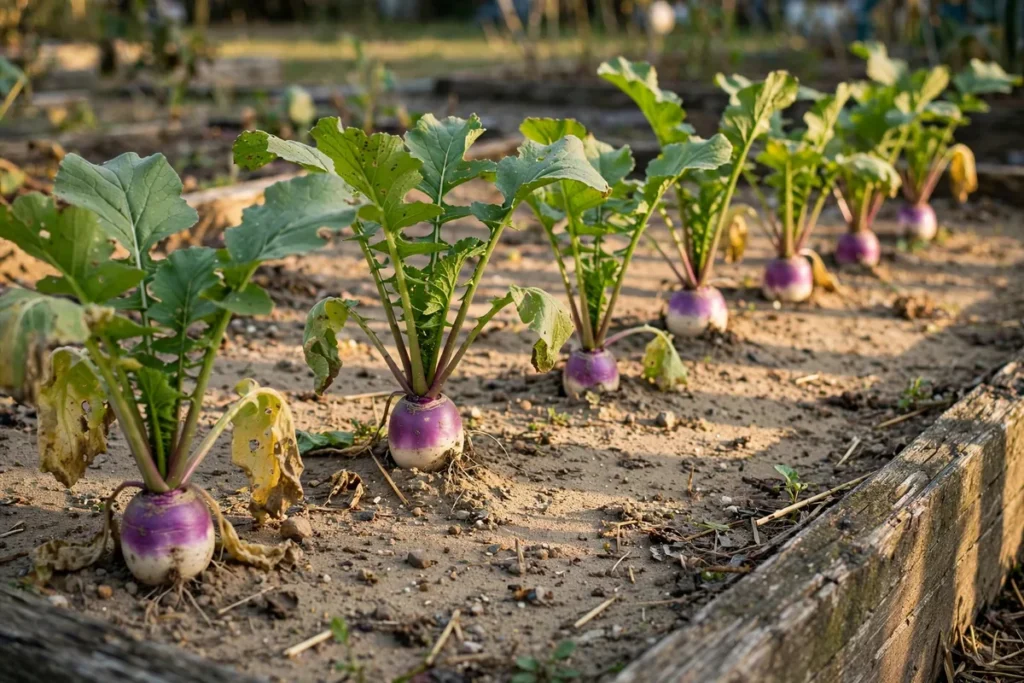
Step 1: Prepare a smooth bed. Loosen the top 6–8 inches and rake the surface smooth. Turnip seed is small, so a fine, clod-free seedbed gives you the even stand you’re after. Pick up a packet of turnip seeds — one packet sows a surprising amount of row.
Step 2: Make shallow furrows. Draw furrows ¼–½ inch deep, 12–18 inches apart. In a raised bed, you can broadcast lightly over a wide band instead — just keep the seed shallow either way.
Step 3: Sow thinly. Sprinkle seed as thinly as you can manage, roughly a seed every inch. Thin sowing now means less thinning later. Cover with ¼ inch of fine soil and press gently.
Step 4: Water in and keep moist. Water with a fine spray so you don’t wash the tiny seeds away. Keep the top half-inch of soil consistently moist until seedlings emerge in 4–7 days — in hot weather that may mean a light watering every day.
Step 5: Mark the row. Note the variety and date on a plant tag. With succession sowings two weeks apart, you’ll be glad you did when harvest time comes.
Spacing and thinning
Here’s the mistake that ruins more turnip crops than anything else: skipping the thinning. Turnip seedlings come up thick, and a thick stand produces a thick stand of leaves with marble-sized roots underneath. The plants can’t swell without elbow room.
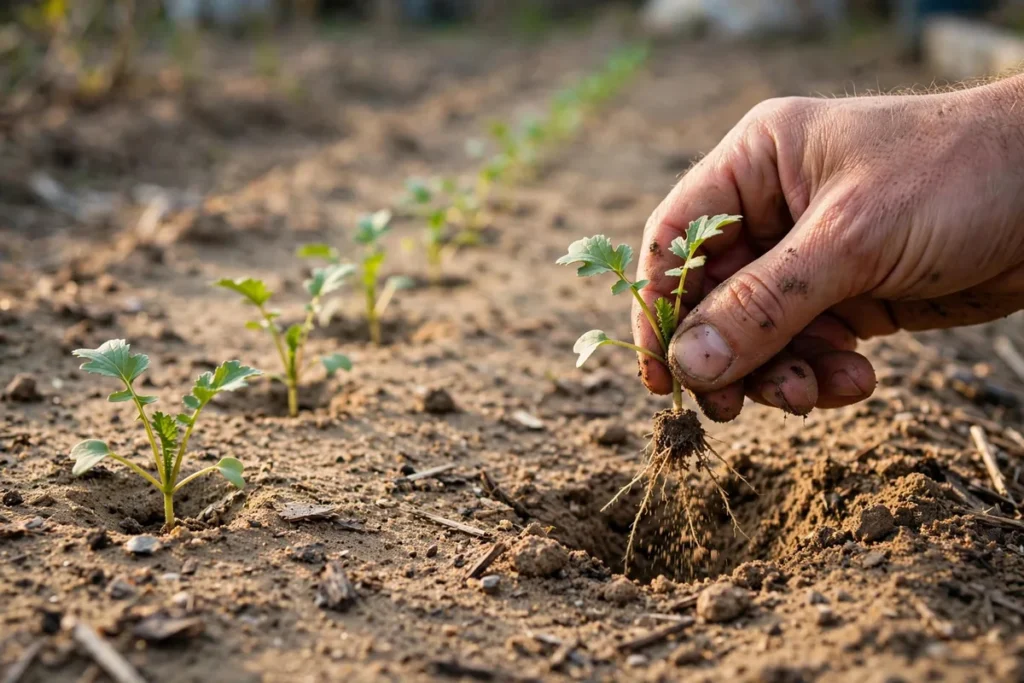
When seedlings are 2–3 inches tall, thin them to 3–4 inches apart for root production. If you’re growing a variety mainly for greens, 2 inches apart is fine — but for roots, give them the full spacing. Thin in damp soil (seedlings pull out easier), and do it in the evening so the remaining plants recover overnight.
The thinnings are edible — young turnip leaves make a fine addition to salads or a quick sauté. Consider it a preview of the harvest to come.
Fall turnip care
Turnips ask for very little once they’re up and thinned. Keep up with these three basics:
Water
About an inch a week, delivered evenly. Turnips are quick growers, and inconsistent water shows up fast — dry spells followed by heavy rain cause cracking, while chronic dryness makes roots hot and woody. Mulch helps enormously here; a couple of inches of straw keeps the soil moisture steady through the dry spells of early fall.
Mulch
Once plants are a few inches tall, mulch around them with 2–3 inches of straw or shredded leaves. Beyond holding moisture, mulch insulates the soil as nights cool and keeps the root shoulders clean. It’s also good timing — spreading mulch pairs naturally with fall garden cleanup, when leaves and straw are abundant.
Fertilizer
Turnips are light feeders and usually need nothing beyond decent soil. If your soil is very poor, a balanced organic fertilizer worked in at planting is plenty. Go easy on nitrogen: too much grows spectacular tops and underwhelming roots. And as with all root crops, skip fresh manure — it encourages forking and odd shapes.
The best turnip varieties for fall
Fall turnip varieties split roughly into three groups: classic storage types, fast salad types you eat raw, and greens types. These are all widely grown, well-documented picks:
Classic roots
Purple Top White Globe — The standard turnip most people picture: purple shoulders, white base, mild flavor. Ready in about 55 days and stores well, which makes it the workhorse of fall plantings. Harvest at 2–3 inches for the best texture.
Golden Ball — A small, golden-fleshed heirloom with a sweet, almost nutty flavor. Takes about 60 days but rewards patience — the flavor is a clear step above standard white types, and it holds well in the ground.
Snowball — A smooth, all-white variety maturing in about 45 days. Tender and mild when picked young, and its clean look makes it a favorite for market-style harvests.
Fast salad turnips
Tokyo Market — Ready in as little as 30–35 days, with small, flat, snow-white roots meant to be eaten raw or lightly cooked. Sow this one for the quickest possible fall harvest.
Hakurei — The Japanese salad turnip that converted many skeptics. Crisp, juicy, and sweet enough to eat like an apple, ready in about 38 days. Best picked at 2 inches — it doesn’t store as long as classic types, so eat it fresh.
Grown for greens
Seven Top — Grown for its abundant, flavorful greens rather than roots (the roots stay small). Sow it thick, cut the leaves when they’re 6–8 inches tall, and it regrows for repeat harvests. A fall staple in Southern gardens.
Red Round — A dual-purpose Dutch type with red skin and white flesh, ready in about 50 days. Good roots at tennis-ball size and plenty of greens along the way.
Harvest: when to pull and how to pick the greens
Size is everything with turnips. The rule is simple and worth memorizing:
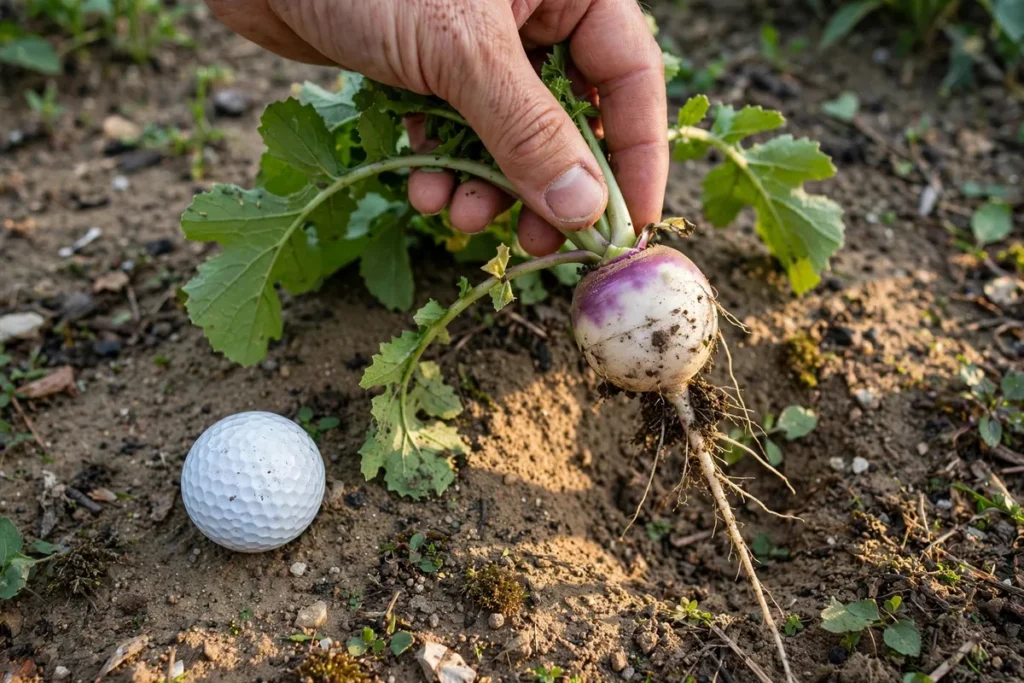
The golf-ball-to-tennis-ball rule
Pull turnips when the roots are between golf-ball size (about 1½ inches) and tennis-ball size (about 2½ inches). In that window they’re crisp, mild, and tender. Past 3 inches, most varieties turn woody, pithy, or unpleasantly strong — the exact turnips that built the crop’s bad reputation.
Start checking once the shoulders push visibly above the soil line. Brush the soil back and feel the size; pull the largest roots first and let the smaller ones keep growing. That staggered harvest stretches one sowing over several weeks. A garden fork loosened under the row makes pulling easy without snapping the roots.
Harvesting the greens
You don’t have to choose between greens and roots — harvest both. Take outer leaves when they’re 6–8 inches tall, leaving the center bud intact so the plant keeps producing. For varieties grown mainly for greens, like Seven Top, you can cut the whole top and it will regrow.
Storing your harvest
Twist or cut the tops off (leaving about half an inch), brush off loose soil without washing, and refrigerate the roots in a bag or crisper drawer — they’ll keep for several weeks. Greens are best used within a few days. In the ground, mulched turnips tolerate light frosts, and the cold only improves their flavor.
Troubleshooting common turnip problems
My turnips are woody and strong-tasting
Almost always a size or heat issue. Roots left to grow past 3 inches get pithy, and turnips maturing in hot weather turn spicy. Sow in the true fall window, harvest at golf-ball to tennis-ball size, and the problem disappears.
The roots are cracking
Cracking comes from uneven watering — a dry spell followed by a soaking rain. Keep soil moisture steady with regular watering and mulch, especially while roots are sizing up.
Tiny holes are appearing in the leaves
Flea beetles love turnip-family seedlings, chewing small shot-holes in the leaves. Young plants usually outgrow the damage, but floating row cover over the row from day one prevents it entirely. Established plants with strong growth rarely suffer.
Germination was poor
The seed likely dried out or the soil was too hot. Turnip seed needs consistent surface moisture for its 4–7 day germination window — in late-summer heat, that can mean daily light watering. Shade cloth or a board over the row (removed at emergence) helps in the hottest weeks.
My turnips bolted before sizing up
Bolting is a stress response — usually a cold snap on very young seedlings or heat stress at sowing. Sowing after the worst summer heat has passed, and keeping seedlings watered, prevents most of it. If a variety bolts, pull it and sow again; there’s usually still time.
FAQs about growing turnips in fall
How late can I plant turnips in fall?
Later than most crops. Because the fastest varieties mature in about 30 days, you can sow Tokyo Market or Hakurei up to a month before your first frost and still harvest. For storage varieties that need 55–60 days, count back accordingly.
Can I grow turnips just for the greens?
Yes — and many gardeners do. Sow a greens variety like Seven Top thickly, harvest the leaves at 6–8 inches, and let them regrow. You can also harvest greens from root varieties; just take outer leaves and leave the center growing.
Why do my turnips taste hot or spicy?
Heat. Turnips grown in warm weather develop a peppery bite; the same variety grown in cool fall weather tastes mild and sweet. If yours are spicy, they likely matured too warm — or were harvested too large.
Do turnips need a lot of fertilizer?
No. They’re light feeders, and excess nitrogen grows big tops with small roots. Decent garden soil is usually enough; a light balanced feeding at planting covers poor soil.
Will turnips survive frost?
Light frosts are fine — they sweeten the roots. A heavy mulch protects roots in the ground through moderate freezes. In mild-winter areas, mulched turnips can be harvested all winter.
More fall vegetable growing posts to explore:
- What to Plant in October: 15 Vegetables for a Fall Garden
- How to Plant Garlic in the Fall: A Step-by-Step Guide
- Fall Garden Cleanup: 12 Things to Do Before Winter
- How to Grow Beets in Fall
Turnips might be the easiest win in the fall garden: sow them in late summer, thin them once, keep the water steady, and pull them at golf-ball to tennis-ball size. Do that and you’ll wonder why the crop ever got a bad name — crisp, sweet roots and a bonus harvest of greens, all in about a month.
Are you giving turnips a spot in your fall garden this year?
Sources & Further Reading
- How to Grow Rutabagas and Turnips in Your Garden — Utah State University Extension. Supports germination, spacing, fall planting timing, and frost tolerance.
- Root Crops (Publication 426-422) — Virginia Cooperative Extension. Supports sowing window, maturity days, and harvest size.
- TURNIP — Kansas State University Extension. Supports fall planting dates, spacing, and varieties.
- It’s Not Too Late to Plant Turnips! – Lycoming County Master Gardener — Penn State Extension. Supports late-summer sowing, thinning, and watering.