
This post may contain affiliate links. If you buy through links on this page, we may earn a commission at no extra cost to you.
As an Amazon Associate I earn from qualifying purchases.
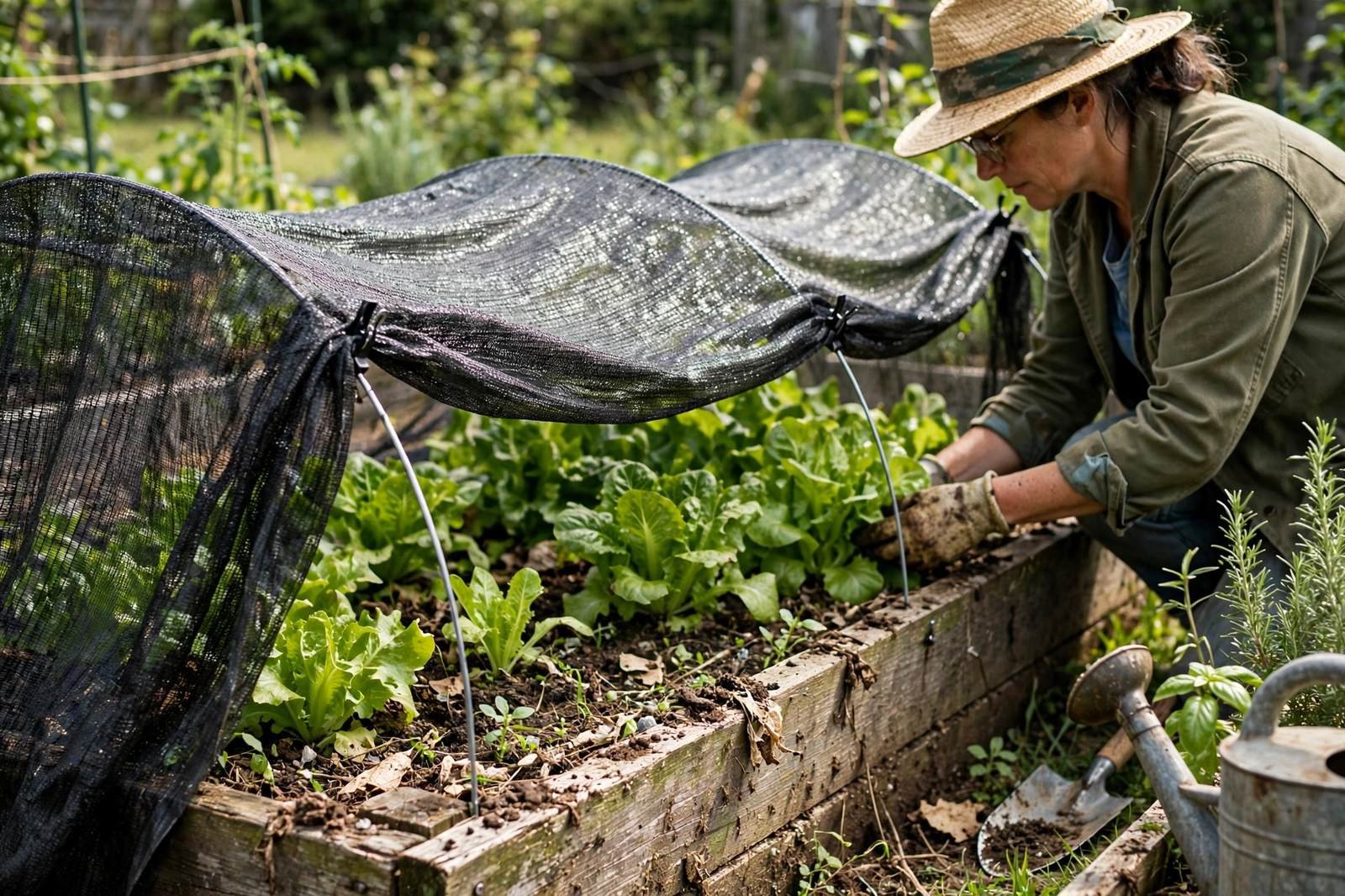
Mid-summer heat does not have to end the salad bed. Lettuce bolts, spinach turns bitter, and transplants wilt at noon even when soil stays moist. Shade cloth buys time: it cuts light, lowers leaf temperature, and slows moisture loss without shutting out rain or air. Match the rate to the crop. Too little and leaves scorch; too much and plants stretch thin.
Our quick answer: most home beds do best with 30 to 40 percent cloth. Use 30 percent for peppers and squash in a short heat wave, 40 percent as the all-purpose choice for mixed beds, and 50 percent for lettuce, spinach, cilantro, and fresh transplants. Knitted cloth suits most gardens; woven often costs less but needs finished edges. Sizing math and crop matches follow.
Quick Comparison: Shade Rate and Cloth Type
Shade rate is the share of light blocked. A 40 percent cloth lets about 60 percent through. Check listings for material, edge finish, and grommet spacing.
| Option | Best fit | Tradeoffs |
|---|---|---|
| 30% shade cloth | Peppers, squash, melons, eggplant, and mixed beds in a short heat wave | Light relief; may not be enough for lettuce or spinach in intense sun |
| 40% shade cloth | Tomatoes, cucumbers, beans, and mixed beds; our default if buying one piece | Good balance of cooling and growth; check airflow on humid days |
| 50% shade cloth | Lettuce, spinach, cilantro, Asian greens, and new transplants | Strong cooling; can slow sun-loving crops if left on too long |
| Knitted HDPE | Most home beds, hoops, and frames where edges get cut to size | Stretchy, resists fraying, handles wind well; can cost more |
| Woven HDPE | Flat covers and budget projects with finished edges | Lays flat, often costs less; cut edges fray unless hemmed |
Compare 40 percent shade cloth for vegetable gardens on Amazon, then check whether the listing states knitted or woven, the exact dimensions, and the edge treatment. A cheap piece that frays at the first cut costs more time than it saves.
Cool-season crops show the benefit first. Our notes on how to grow lettuce in fall cover the same crops from the other end of the season, when light returns and covers come off.
Shade Rate Is a Crop Decision, Not a Guess
A pepper in full sun makes fruit. A lettuce plant in the same sun makes a bitter stalk. Shade cloth lets us split that difference bed by bed.
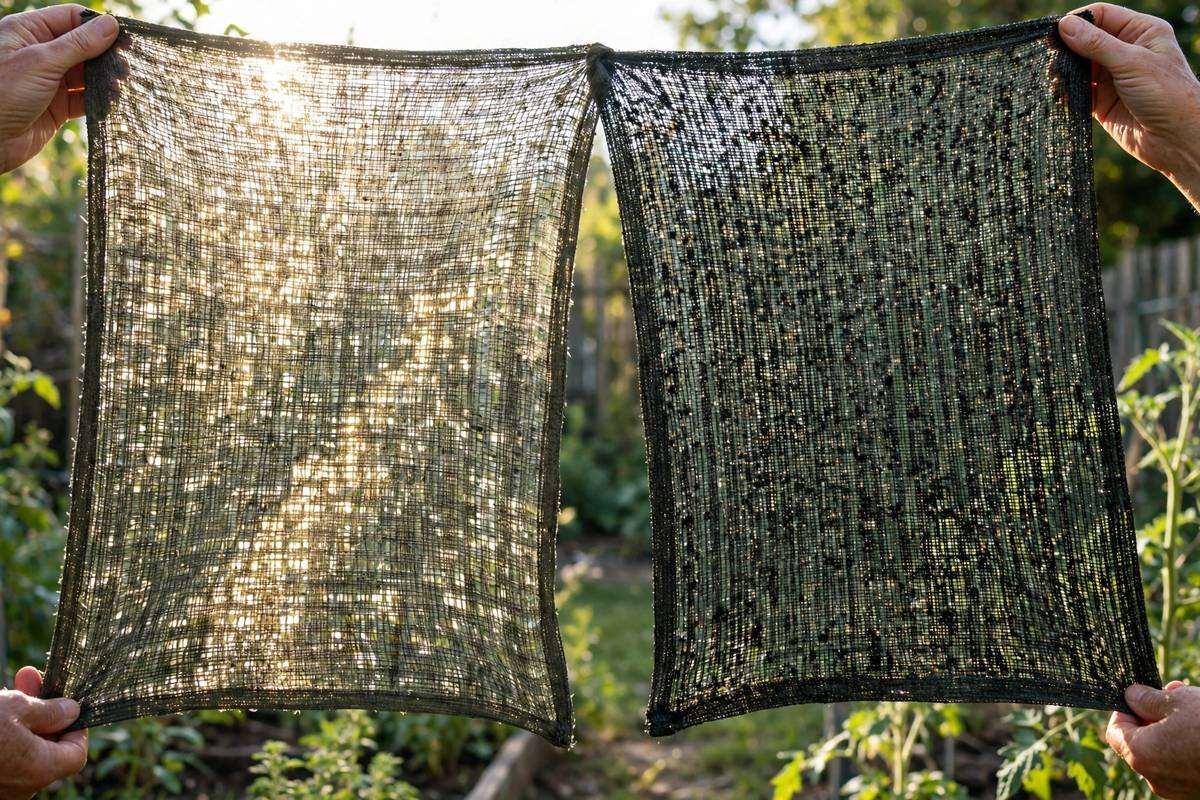
Hold two rates up to the sky and the gap is plain. The looser weave throws a speckled shadow; the tighter weave throws an even, darker one. Shaded leaves stay closer to air temperature, so plants wilt less, bolt slower, and scorch less at the edges.
30 Percent: Light Relief for Sun Lovers
Pros:
- Keeps peppers, squash, melons, and eggplant growing through a brief heat wave.
- Lets tomatoes keep ripening while easing sunscald on exposed fruit.
- Works well as a first piece if the garden rarely sees extreme heat.
Cons:
- May not cool lettuce, spinach, or cilantro enough during a long hot stretch.
- Offers modest help for fresh transplants that wilt at noon.
40 Percent: The All-Purpose Rate
Pros:
- Balances cooling and light for mixed beds with tomatoes, cucumbers, beans, and greens.
- Helps prevent sunscald while keeping growth steady.
- One piece can rotate from bed to bed as crops change.
Cons:
- Can be strong for shade-grown herbs in mild weather if left on without need.
- Needs open ends or lifted sides on humid days to keep air moving.
50 Percent: Strong Shade for Cool-Season Crops and Transplants
Pros:
- Extends lettuce, spinach, and cilantro harvests into warmer weeks.
- Protects new transplants while roots settle.
- Cools the soil surface, which slows moisture loss on bright days.
Cons:
- Slows peppers, squash, and other sun lovers if it stays on past the heat.
- Can stretch seedlings leggy if used in low light.
Browse 50 percent shade cloth options on Amazon by exact size for the greens bed.
Water still matters under cloth. Shade slows evaporation, but it does not replace watering. Our guide on how to keep container soil from drying out too fast covers the same moisture logic for pots, where heat and wind pull water even faster.
Knitted vs Woven: The Honest Tradeoffs
Most garden shade cloth is high-density polyethylene, called HDPE for short. Knitted cloth loops yarn into a stretchy mesh. Woven cloth crosses flat tapes over and under each other like a tarp.
Knitted cloth resists fraying when cut, stretches over hoops, and handles wind well, though it can cost more and look wavy if pulled unevenly. Woven cloth lays flat and often costs less, but cut edges fray unless hemmed or bought finished. For most raised beds we choose knitted. For a flat fixed frame, woven can save money. Check listings for UV-stable wording either way.
Hoops, Clips, and Airflow
Shade cloth works best with air space between the cloth and the leaves. Cloth laid flat on foliage can trap heat at contact points and rub stems in wind. Hoops lift the cloth into a low tunnel. Clips hold it without holes.
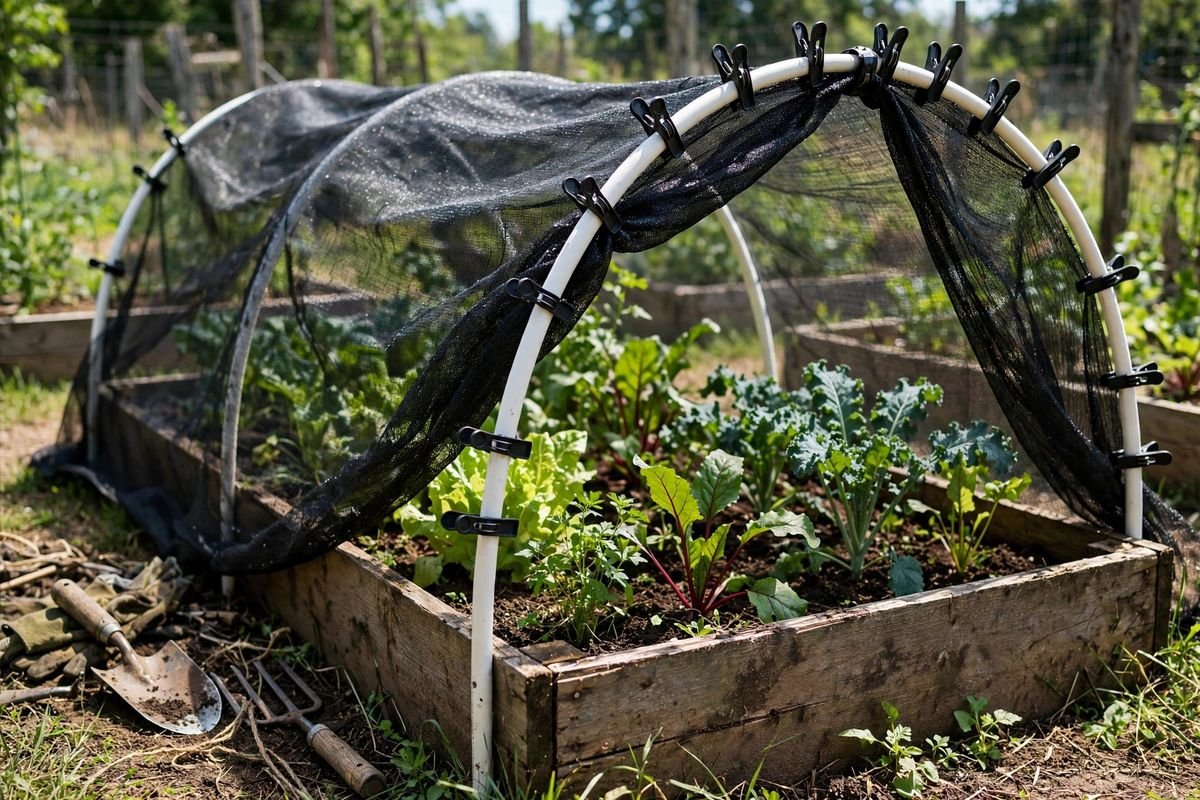
Set hoops every 2 to 3 feet along the bed. Push each end 6 to 8 inches into the soil or clamp it to the frame. Drape the cloth over the top, center it, and clip at each hoop. Leave the ends open. Open ends let hot air escape and keep humidity from building on still days. On windy days, add clips at the soil line or weigh the skirt with boards or bricks.
Lift one side on calm, humid days if leaves stay wet late into the morning. Leaf spots spread faster in still, damp air. If foliage dries by mid-morning, the setup is fine; if not, open the sides wider.
The same hoop frame earns its keep across seasons. In our notes on how to protect raised beds from frost, hoops carry frost fabric in the cold months. One frame, two covers, and the bed stays in service longer each year.
A Worked Example: Sizing Cloth for One 4×8 Bed
Cloth sold flat has to cover a curve. Buying by bed length and width alone leaves the sides short. Here is our worked example with stated assumptions, so the math can be checked before ordering.
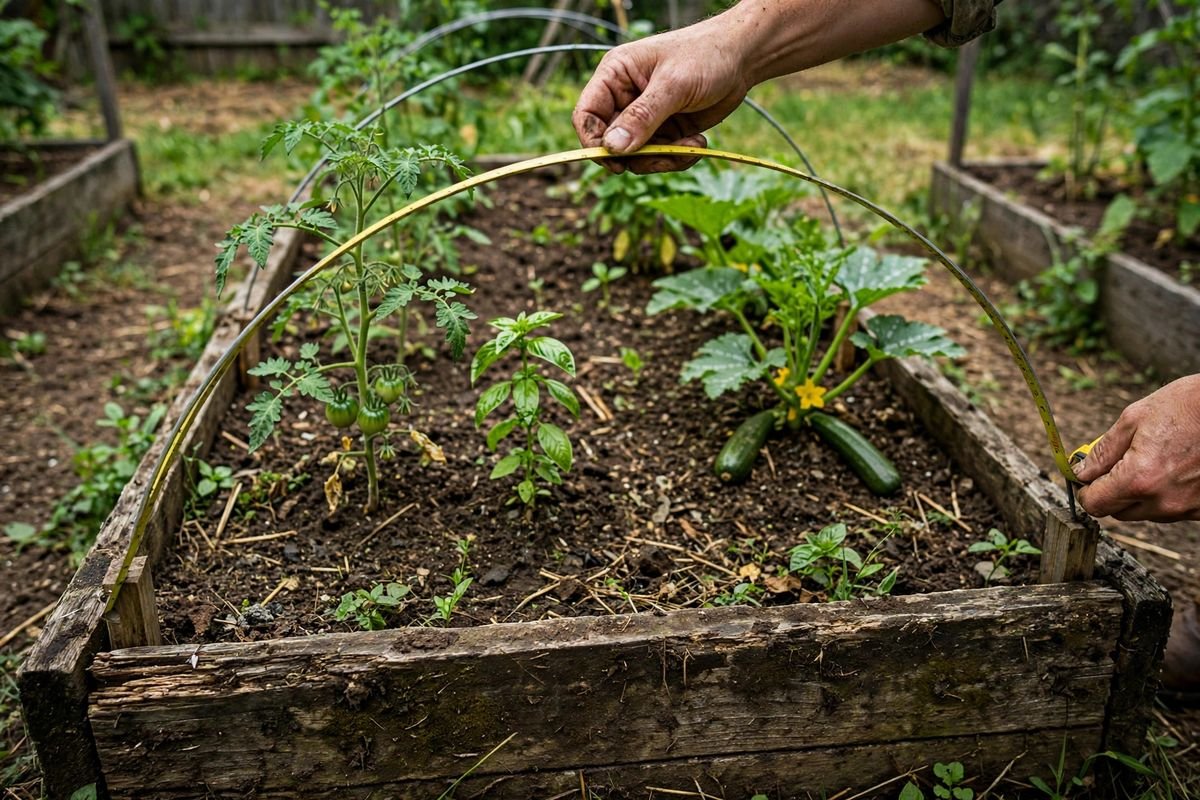
Assumptions. The bed is 4 feet wide and 8 feet long. Hoops rise about 2 feet above the soil at the center. We treat the hoop curve as a half-circle for a quick estimate, then add slack. Cloth needs to reach the soil or bed edge on both sides, plus a few inches to clip or weigh down. We add about 12 inches of extra length for end overhang.
Step 1: arc length across the bed. A half-circle with a 4-foot width has a radius of 2 feet. Half the circumference is pi times the radius: 3.14 times 2 feet equals about 6.3 feet. Real hoops sit a bit flatter than a perfect half-circle, so the true arc often lands between 6 and 6.5 feet. We use 6.5 feet to stay safe.
Step 2: add side slack. Add about 6 inches per side for clipping and tuck: 6.5 feet plus 1 foot equals 7.5 feet across. A cloth width of 8 feet covers that with room to spare, and extra width can hang as a skirt on the sunny side.
Step 3: length along the bed. Bed length is 8 feet. Add about 12 inches total for end overhang: 8 feet plus 1 foot equals 9 feet. A 10-foot length gives adjustment room at both ends.
Result. For one 4×8 bed on 2-foot hoops, an 8 by 10 foot cloth is a sound buy. It covers the arc, reaches the edges, and leaves slack for clips. A 6 by 8 foot piece, which matches the flat bed size, would fall short over the hoops and pull tight at the center. Tight cloth rubs leaves and tears sooner at clip points.
Measure the real arc with a soft tape if hoops rise higher than 2 feet; taller hoops need more width than the estimate.
Compare 8 by 10 knitted shade cloth on Amazon and confirm the listing dimensions match the details.
When to Put It On and When to Take It Off
Put cloth on when highs stay hot for several days, or when transplants wilt at noon despite moist soil. Lettuce flops and browns at the edges first, then bolts. Peppers and tomatoes show sunscald on exposed fruit. Those plant signs beat any fixed temperature number.
Use your local frost dates and regional planting guidance — not your USDA hardiness zone alone — to choose planting dates. Local extension calendars also note when cool-season crops struggle in heat, which pairs well with a shade plan.
Take cloth off when a cooler stretch arrives, when crops stretch toward light, or when foliage stays wet too long. Fruiting crops need full light to ripen once heat eases. A simple rhythm works: cloth on for the heat wave, one side lifted on mild days, cloth off when the spell breaks.
Store cloth dry and out of the sun to extend its life.
Our Verdict: Match Rate to Crop, Then Buy for the Arc
One common mistake is buying the flat bed size and the wrong rate. Match rate to crop first, then size for the curve.
Choose 30 percent shade cloth if the bed holds peppers, squash, melons, or eggplant and heat comes in short waves.
Choose 40 percent shade cloth if one piece must serve mixed beds, tomatoes, and cucumbers across the summer. This is our default pick for most home gardens.
Choose 50 percent shade cloth if the bed holds lettuce, spinach, cilantro, or fresh transplants that wilt fast in strong sun.
Choose knitted cloth if edges will be cut to fit hoops or odd shapes, or if wind works the bed hard.
Choose woven cloth if the cover is a flat, fixed rectangle with finished edges and cost per square foot matters most.
Our bottom line: buy 40 percent knitted cloth sized for the arc, clip it over hoops with open ends, and give the greens bed its own 50 percent piece when needed.
Frequently Asked Questions
Does shade cloth keep rain out?
No. Rain passes through the mesh. Soil still gets wet, and watering needs continue under cloth. Heavy rain can pool on a flat span, which is another reason to use hoops and a slight slope.
Can shade cloth stay on all summer?
It can, but growth slows for sun-loving crops. We put it on for heat and lift or remove it during cooler stretches. Greens tolerate a longer run under cloth than peppers or squash do.
How long does shade cloth last?
UV-stable HDPE cloth often lasts several seasons when stored dry and out of the sun. Cloth left out all winter, or stored damp, wears faster at folds and clip points.
Sources & Further Reading
- University extension guidance on shade cloth rates for vegetables, heat stress, and bolting in leafy greens.
- Regional extension notes on hoop houses, low tunnels, airflow, and disease management under covers.
- Extension planting calendars using local frost dates and regional timing for cool-season and warm-season crops.