
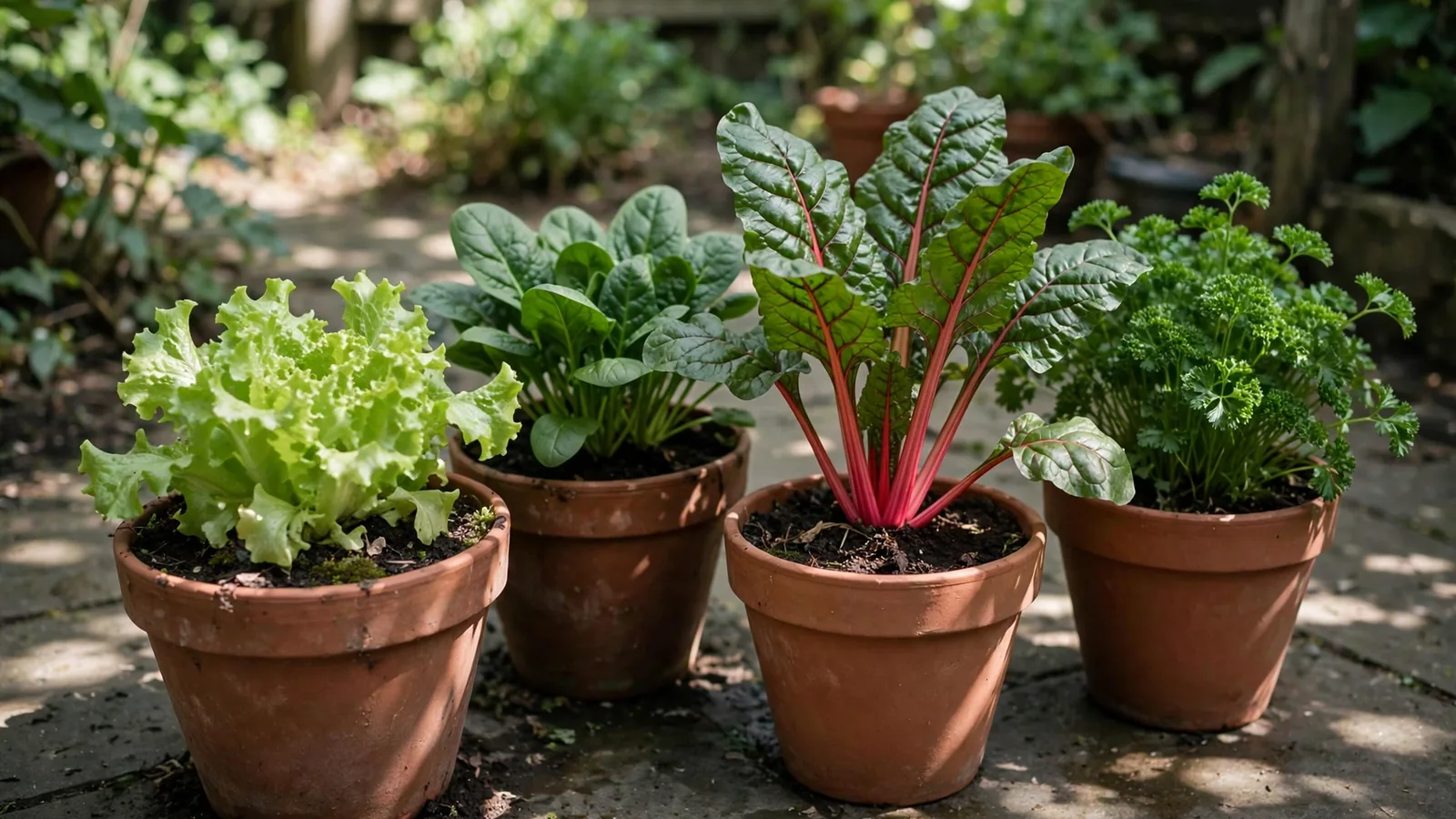
Here’s the honest truth most garden content won’t print: tomatoes, peppers, and cucumbers will not produce in shade. They’ll grow leggy, flower hopefully, and give you nothing. But a shady patio is far from hopeless — leafy greens, herbs, and a few root crops genuinely thrive on 3–4 hours of direct sun, and some prefer it. This plan grows what the light allows instead of fighting it.
This is a planning guide, not a grow log. The layout diagram and header image are AI-generated illustrations (labeled as such) — they show the arrangement, not a real patio.
Who this setup is for
Gardeners with a north-facing patio, a balcony shaded by the building, or a yard under tree canopy — anyone whose sun audit came back at 3–4 hours of direct light. Also for hot-climate gardeners whose “shade” is the only spot where lettuce survives July.
Space required
About 20 square feet — a 4×5-foot patio corner. Six pots clustered where the available sun lands longest. Map your light first: note which spot gets the 3–4 hours, and put the pots exactly there, not where they’d look nicest.
Sun requirements
3–4 hours of direct sun, or bright dappled light all day. This is the defining constraint — every crop below is chosen for it. If you get 5+ hours, you have more options (see the 6-pot balcony plan). Under 3 hours, grow houseplants — even lettuce gives up eventually.
One advantage nobody mentions: shade gardens need less water and bolt later. Your lettuce will outlast your sunny neighbor’s by weeks.
The layout
Group by harvest style: cut-and-come-again greens together (you’ll visit them daily with scissors), herbs at the front edge for easy snipping.
- Back row: Pot A (Swiss chard), Pot B (kale)
- Middle row: Pot C (lettuce), Pot D (spinach + arugula)
- Front row: Pot E (parsley + cilantro), Pot F (mint)
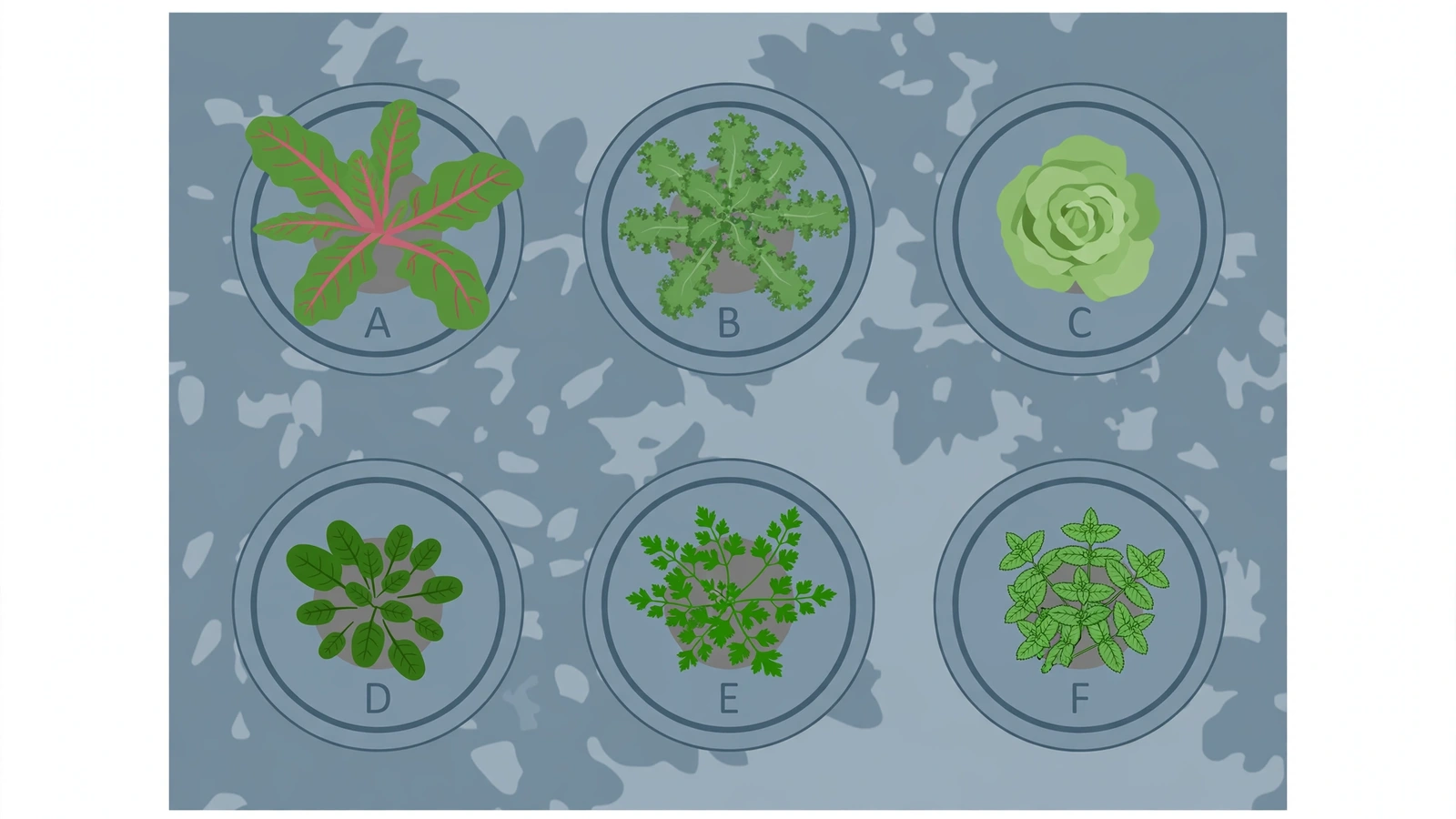
Illustration: overhead diagram of six labeled pots on a shaded patio — chard and kale in back, lettuce and spinach-arugula in the middle, herbs in front.
What to plant: specific varieties
All leafy, all shade-tolerant, all honest about what “tolerant” means (they produce — just slower than in full sun).
| Pot | Crop | Variety | Notes |
|---|---|---|---|
| A (3 gal) | Swiss chard | ‘Bright Lights’ | The most shade-forgiving green here; harvest outer stalks for months |
| B (3 gal) | Kale | ‘Lacinato’ | Slower in shade but steady; sweetens after light frost |
| C (12 in) | Lettuce | ‘Salad Bowl’ | Cut outer leaves; bolts far later in shade than sun |
| D (3 gal) | Spinach | ‘Bloomsdale’ | Sow in cool weather — spring and fall, not midsummer |
| D | Arugula | ‘Astro’ | Shares the pot; harvest young or it gets peppery |
| E (2 gal) | Parsley | ‘Italian Flat Leaf’ | Biennial; shade keeps it tender |
| E | Cilantro | ‘Slow Bolt’ | The one cilantro that stands a chance — still sow every 3 weeks |
| F (2 gal) | Mint | Spearmint | Solo pot; thrives on the neglect shade gardeners give it |
What you won’t find here: tomatoes, peppers, beans, squash, or basil (it survives shade but tastes watery). Anyone telling you otherwise is selling something.
Containers, soil, and the math
Same container logic as any pot garden: drainage holes, saucers, potting mix (not garden soil). Shade pots stay wetter longer, so mix extra perlite into every pot — roughly one part perlite to four parts mix.
Soil volume — 1 gallon = 0.134 cubic feet:
- Pots A, B, D (3 gal each): 3 × 0.40 = 1.20 cu ft
- Pot C (12 in ≈ 2.5 gal): 0.34 cu ft
- Pots E, F (2 gal each): 2 × 0.27 = 0.54 cu ft
Total: 2.08 cubic feet. Buy about 2.5 cubic feet of material — two 1-cu-ft bags of potting mix plus a small bag of perlite gets you there, with room for settling.
Watering
Shade changes the watering equation: pots dry slower, and overwatering becomes the main killer instead of underwatering. Water only when the top 2 inches are dry — in a shady spot that might mean twice a week, not daily. The finger test still rules. Empty saucers after watering; roots sitting in water in a cool shady corner invite root rot fast.
Equipment list
- 3 × 3-gallon pots, 1 × 12-inch pot, 2 × 2-gallon pots (drainage holes + saucers)
- 2.5 cu ft potting mix + small bag of perlite
- Seed packets: chard, kale, lettuce, spinach, arugula, parsley, cilantro, mint (or one mint transplant)
- Balanced liquid fertilizer (half-strength monthly — shade plants grow slower and need less)
- Harvest scissors
Estimated budget
Typical US retail, September 2026:
| Item | Est. cost |
|---|---|
| 6 pots + saucers | $32 |
| 2.5 cu ft potting mix | $24 |
| Perlite (small bag) | $6 |
| 7–8 seed packets | $28 |
| Liquid fertilizer | $10 |
| Harvest scissors | $8 |
| Total | ~$108 |
Seeds are the whole planting cost — leafy greens all sow directly, no transplants needed.
Must buy / Nice to have / Skip
Must buy: the perlite (non-negotiable in shade — drainage is everything), potting mix, seeds of actual shade-tolerant varieties. Generic “lettuce mix” is fine; generic “vegetable seeds” hope is not a plan.
Nice to have: a small fan for air circulation if the spot is both shady and still (cuts fungal problems), a light meter app on your phone to verify the 3–4 hours instead of guessing.
Skip: “shade vegetable” seed collections at premium prices (they’re repackaged lettuce and spinach), grow lights for an outdoor patio (if you’re buying lights, grow indoors instead), and copper “slug tape” — the evidence for it is thin; a saucer of beer sunk to the rim works better, or just check under pots at dusk.
What changes the plan
- Deep shade (under 3 hours)? Honest answer: vegetables are done. Grow mint, parsley, and ornamental shade plants, and put your vegetable energy into a community garden plot or a friend’s sunny yard.
- Hot climate (Zone 9+)? Your shady patio is actually prime real estate — it’s where lettuce, spinach, and cilantro survive summer. Sow heat-tolerant varieties (‘Jericho’ lettuce, ‘New Zealand’ spinach) and garden year-round.
- Slugs? Shade + moisture = slug paradise. Check under pots at dusk, keep the area clear of debris, and don’t mulch heavily — mulch is slug housing.
- Dappled light vs. solid shade? Dappled light under a tree all day often outperforms 3 hours of harsh direct sun for greens. If your tree spot is bright, try the kale and chard there first.
- Pots against a north-facing wall? A light-colored wall bounces useful light back onto the plants; a dark fence swallows it. If you can choose, set the pots a foot out from a white or pale wall — the reflected light can make a real difference in a marginal spot.
For sowing windows in your climate — spinach and cilantro are picky about timing — check Garden Pulse or build a calendar in Start Seeds.
Related guides and tools
- Container Garden Builder — match pots, plants, and care to your light
- Raised Bed Builder — plan a bed for your sunny spots
- Start Seeds — sowing dates for cool-season greens by ZIP code
- All garden tools — browse every free tool
- Garden Pulse — what to do in your garden right now
- Garden Inbox — your planting windows, tracked week by week