
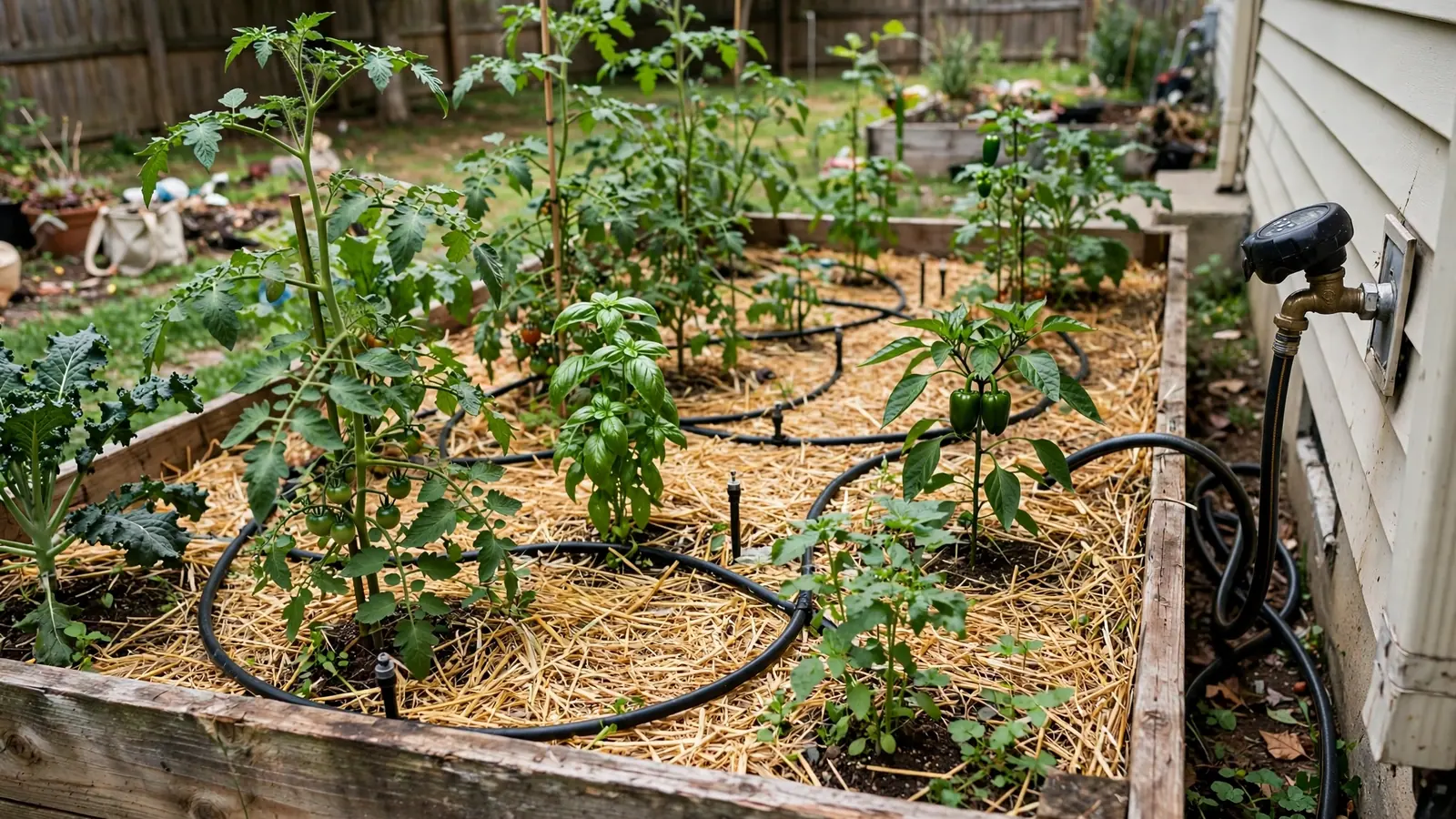
Most gardens don’t fail from bad soil or wrong varieties. They fail because watering is a daily chore and daily chores lose to real life by mid-July. This plan is built around that truth: one 4×4 bed, drip irrigation on a timer, heavy mulch, and crops chosen to forgive a missed week. Your job drops to about 20 minutes a week — mostly harvesting.
This is a planning guide, not a grow log. The layout diagram and header image are AI-generated illustrations (labeled as such) — they show the arrangement, not a real garden.
Who this setup is for
Someone who wants homegrown food but works full-time, travels, or just knows themselves: the garden has to survive benign neglect. If you’ve killed plants by forgetting them (not by over-caring), this plan is engineered for you.
Space required
A 6×6-foot area for a 4×4 bed with working room — plus access to an outdoor spigot within hose reach. The spigot is non-negotiable: the entire low-maintenance strategy depends on a hose timer, and running 100 feet of hose across the yard is how systems get “temporarily” disconnected.
Sun requirements
6+ hours of direct sun. Low-maintenance doesn’t mean low-light — the crops below still need sun to produce. What we’re minimizing is your labor, not the sun.
The layout
One 4×4 bed, drip lines running north–south, crops grouped by water need. Perennial herbs anchor the north edge (plant once, harvest for years); annual vegetables fill the rest.
| West | East | |||
|---|---|---|---|---|
| North row | Rosemary (perennial) | Thyme + oregano (perennials) | Cherry tomato (cage) | Cherry tomato (cage) |
| Row 2 | Pepper | Pepper | Zucchini (1 plant, spans 2 squares) | Zucchini |
| Row 3 | Kale | Kale | Bush beans | Bush beans |
| Row 4 (south) | Garlic (fall plant) / lettuce | Lettuce | Marigold | Marigold |
The garlic goes in after the first frost in fall and gets ignored until June — the ultimate busy-person crop. In spring, that square holds lettuce instead.
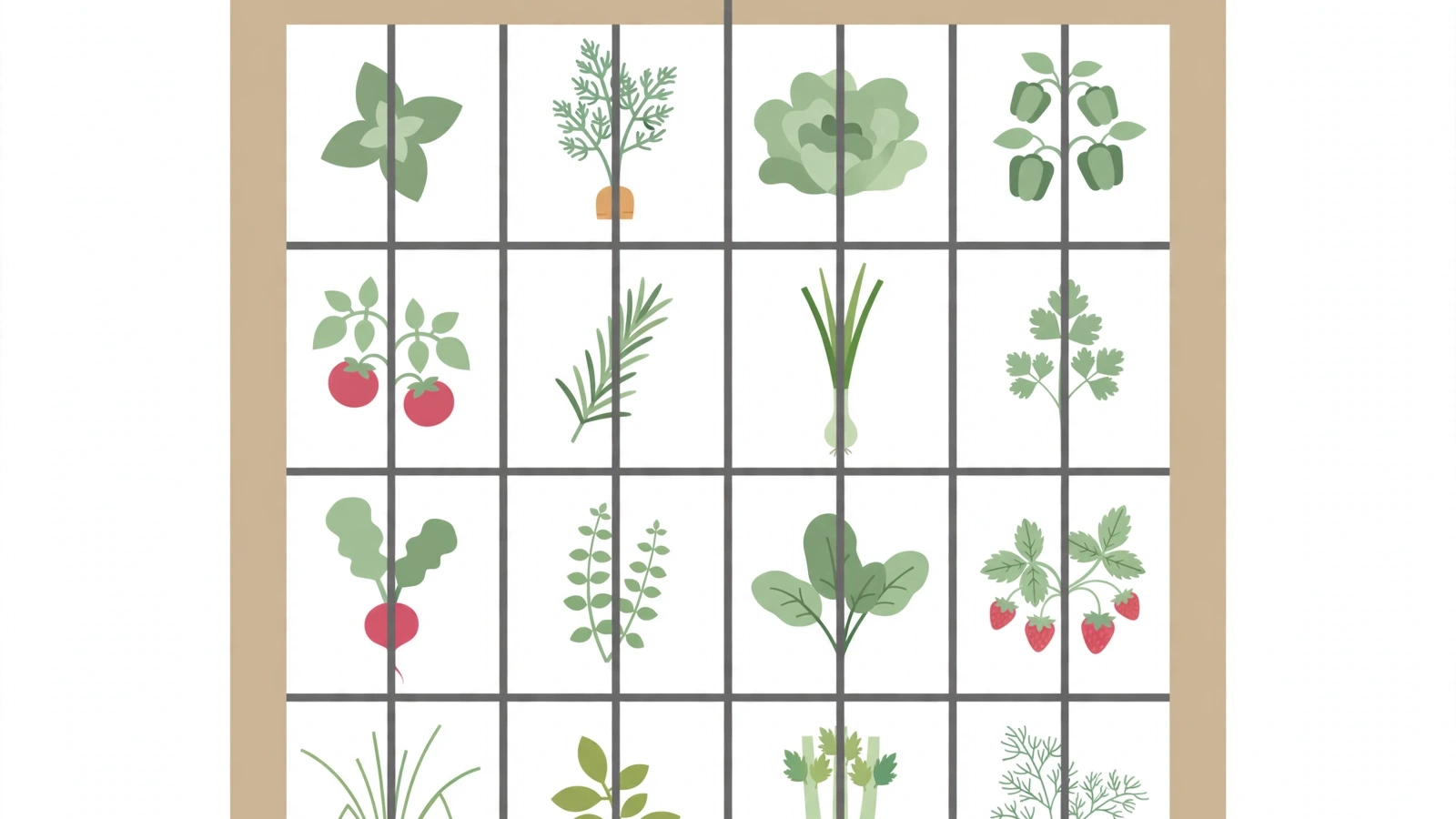
Illustration: overhead diagram of a 4×4 bed with drip irrigation lines, perennial herbs along the north edge, and vegetables grouped by water need.
What to plant: specific varieties
Every variety below was chosen for one trait: it keeps producing with minimal intervention.
| Crop | Variety | Why it’s low-maintenance |
|---|---|---|
| Cherry tomato | ‘Sweet Million’ | Indeterminate but crack-resistant; produces through neglect better than big slicers |
| Pepper | ‘California Wonder’ | Stocky plants, no staking needed |
| Zucchini | ‘Black Beauty’ | One plant feeds a neighborhood; harvest every 2–3 days or get baseball bats |
| Kale | ‘Lacinato’ | Cut outer leaves for months; shrugs off light frost |
| Bush beans | ‘Provider’ | No trellis, no fuss; pick every few days at peak |
| Lettuce | ‘Salad Bowl’ | Cut-and-come-again; shade it in heat or let it bolt and replant fall |
| Garlic | ‘Music’ (hardneck) | Plant cloves in fall, mulch, ignore until scapes appear in June |
| Rosemary / thyme / oregano | ‘Tuscan Blue’ / ‘English’ / Greek | Perennials — the only work is harvesting |
Notice what’s missing: corn (needs a block for pollination), head lettuce (one shot, then done), and anything described as “heavy feeder” that demands constant fertilizing.
The bed, soil, and the math
Same 4×4 bed as our beginner plan: 4 × 4 × 1 ft deep = 16 cubic feet of soil — eleven 1.5-cu-ft bags at roughly $10 each (~$110), or bulk delivery for less. The difference in this plan is what goes on top: 3–4 inches of straw mulch over every bare inch of soil. Mulch is the unsung hero of low-maintenance gardening — it cuts watering needs roughly in half, suppresses weeds (your other big time sink), and keeps soil temperature stable.
Watering: the automation core
This is the section that makes the plan work. Buy two things:
1. A drip irrigation kit (~$40–$60 for a 100-ft kit with adjustable emitters). Snake the main line down the middle of the bed with emitter lines branching to each row. Drip puts water at the root zone — no evaporation waste, no wet leaves (which means less disease). 2. A hose-end timer (~$30–$40). Set it for deep watering 2–3 times a week: 45–60 minutes per session for drip in a raised bed, adjusted for your climate. A rain-delay feature is worth the extra $10.
Installation takes an afternoon the first time, then watering becomes something that happens while you’re at work. Check the emitters monthly — a clogged emitter is the one failure mode, and it takes 30 seconds to clear. Total hands-on watering time per week after setup: zero.
Equipment list
- 4×4 raised bed kit
- 16 cu ft raised-bed soil mix
- Straw mulch (1 bale)
- Drip irrigation kit (100 ft with adjustable emitters)
- Hose-end timer with rain delay
- 2 tomato cages
- Slow-release vegetable fertilizer (one spring application)
- Transplants: 2 cherry tomatoes, 2 peppers, 1 zucchini
- Seeds: kale, bush beans, lettuce
- Garlic seed cloves (order in summer for fall planting)
- Perennial herb transplants: rosemary, thyme, oregano
Estimated budget
Typical US retail, September 2026:
| Item | Est. cost |
|---|---|
| Cedar 4×4 bed kit | $72 |
| 11 bags raised-bed mix | $110 |
| Straw mulch | $10 |
| Drip kit (100 ft) | $50 |
| Hose-end timer | $35 |
| 2 tomato cages | $14 |
| Fertilizer | $13 |
| Transplants (5) + herbs (3) | $32 |
| Seeds (3 packets) + garlic cloves | $22 |
| Total | ~$358 |
The irrigation adds ~$85 over a hand-watered bed. It pays for itself the first time you don’t lose a bed of tomatoes to a forgotten heat wave — or price out what a week of vacation plant-sitting costs.
Must buy / Nice to have / Skip
Must buy: the timer and the mulch. The bed and plants are obvious; these two are what actually make it low-maintenance. Skip either and you have a regular garden with a marketing slogan.
Nice to have: a rain barrel feeding the drip system (free water, but adds complexity — year two project), landscape fabric under the mulch paths around the bed.
Skip: self-watering planters for the whole garden (expensive at scale; the drip system does the same job), “water-retaining gel crystals” (marginal benefit, and they break down), and any crop that needs daily picking at peak ripeness (looking at you, okra).
What changes the plan
- No spigot nearby? This plan doesn’t work without one. Use the container plan with self-watering pots instead.
- You travel for weeks? Add a second timer zone… simpler: have someone harvest the zucchini and tomatoes mid-trip. Unpicked zucchini becomes a club; unpicked tomatoes split and rot.
- Clay soil underneath and no drainage? The bed’s own 12 inches of mix handles it — that’s the point of raised beds.
- Winter interest? The garlic and perennial herbs keep the bed alive-looking through winter. In spring, the same timer and lines water your new plantings.
For week-by-week timing that adapts to your climate, Garden Pulse tells you what’s due now, and Garden Inbox tracks your windows across the season.
Related guides and tools
- Raised Bed Builder — custom bed sizes with soil, lumber, and watering plans
- Container Garden Builder — the low-effort container alternative
- Start Seeds — sowing dates for your ZIP code
- All garden tools — browse every free tool
- Garden Pulse — what to do in your garden right now
- Garden Inbox — your planting windows, tracked week by week