
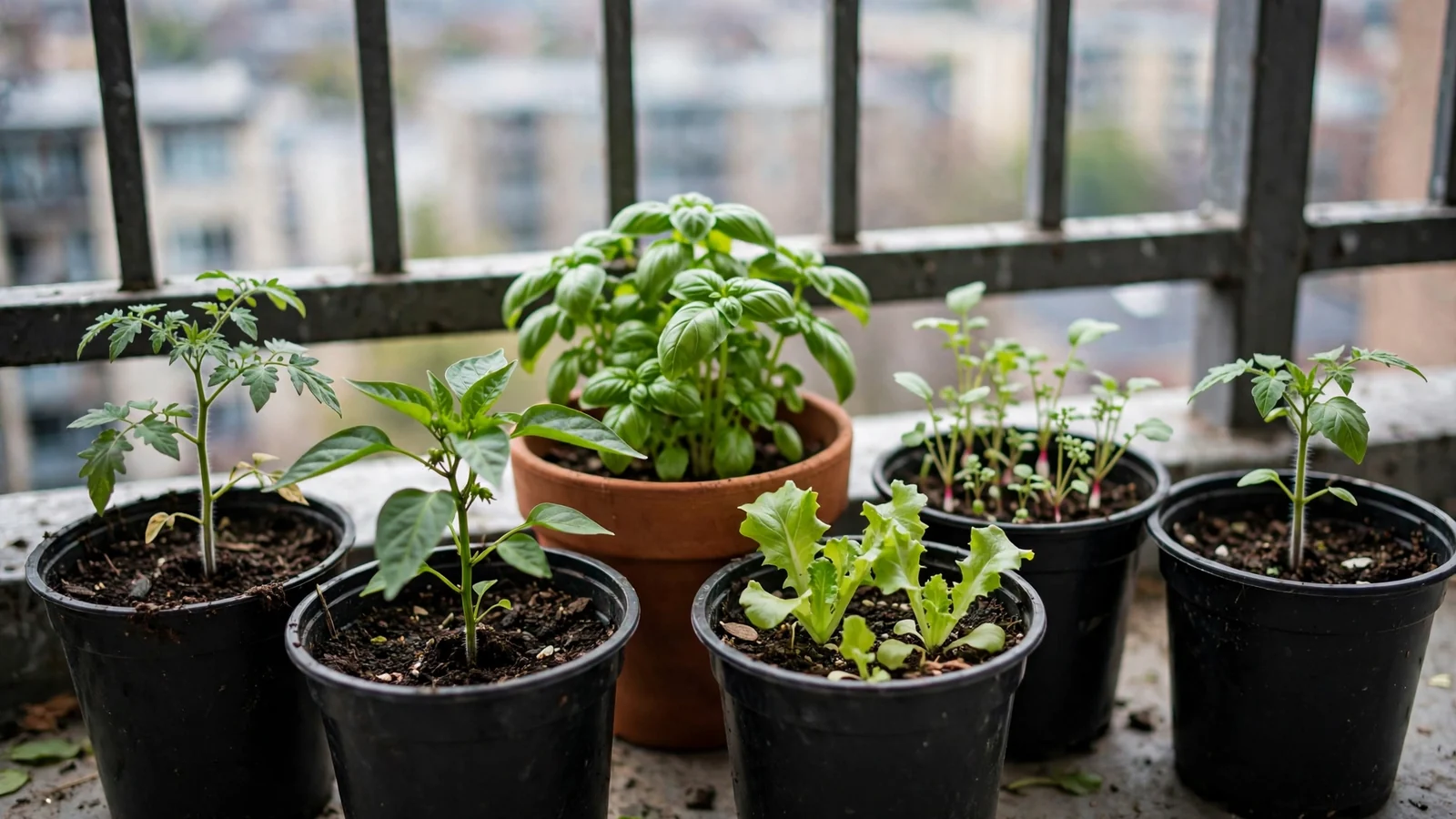
You don’t need a yard to grow real food. Six pots on a balcony can produce salads, fresh herbs, and tomatoes all summer — if the pots are the right size, the varieties are bred for containers, and you water like you mean it. This plan gives you all three: an exact pot list, the soil math, and a variety for every pot.
This is a planning guide, not a grow log. The layout diagram and header image are AI-generated illustrations (labeled as such) — they show the arrangement, not a real balcony.
Who this setup is for
This plan fits a first-time gardener with a balcony, rooftop corner, or small patio — roughly a 4-by-6-foot area. It’s built for someone who wants meaningful harvests (not one sad basil plant) without buying a raised bed or asking a landlord for permission to dig. If you can carry a bag of soil up the stairs, you can build this in a weekend.
Space required
You need about 24 square feet — a 4×6-foot corner works, and so does a 3×8-foot strip along a railing. Each pot sits on a saucer, and the two 5-gallon pots anchor the back row. Two practical notes:
- Weight. Three cubic feet of moist potting mix weighs roughly 120–150 pounds total, spread across six pots. Most residential balconies handle this fine when the weight is distributed, but if your building has posted load limits or the balcony feels bouncy, ask your landlord before loading it up.
- Drainage. Every pot needs a saucer. Balcony floors and downstairs neighbors do not appreciate muddy runoff.
Sun requirements
This plan needs 6 or more hours of direct sun per day — the tomato and pepper won’t produce in less. Watch your balcony for a full day before buying anything; “bright” is not the same as “direct sun.” If your space gets under 4 hours of direct sun, this isn’t your plan — see our shady patio container garden instead.
The layout
Arrange the pots in two rows of three. Tall plants go in back (against the wall or railing) so they don’t shade the short ones.
- Back row, left to right: Pot A (tomato), Pot B (pepper), Pot C (basil)
- Front row, left to right: Pot D (lettuce), Pot E (radishes), Pot F (chives)
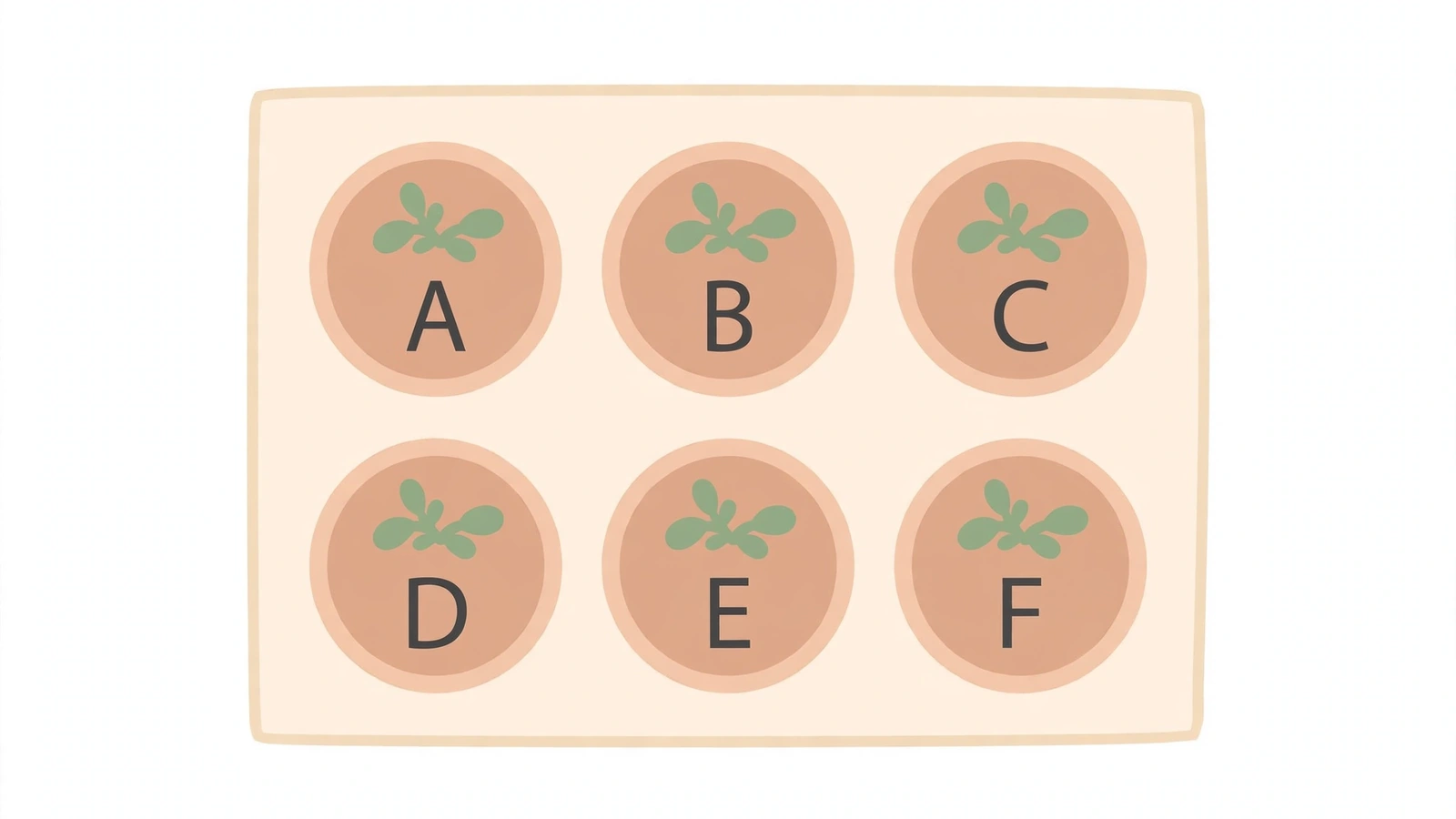
Illustration: overhead diagram showing pots A through F arranged in two rows on a balcony, with the tomato and pepper in the back row.
What to plant: specific varieties
These varieties were chosen because they’re compact, container-proven, and widely available as seeds or transplants in the US. Nothing exotic — your local garden center will carry most of them.
| Pot | Crop | Variety | Why this one |
|---|---|---|---|
| A (5 gal) | Tomato | ‘Patio’ | Determinate dwarf bred for containers; stays 2 feet tall, no sprawling |
| B (5 gal) | Sweet pepper | ‘Lunchbox’ orange | Compact plants, heavy yields of snack-size peppers |
| C (3 gal) | Basil | ‘Genovese’ | The classic pesto basil; pinch flowers to keep leaves coming |
| D (12 in) | Lettuce | ‘Salad Bowl’ | Cut-and-come-again; harvest outer leaves for weeks |
| E (3 gal) | Radish | ‘French Breakfast’ | Ready in ~25 days; sow a new pinch every 2 weeks |
| F (2 gal) | Chives | Common chives | Perennial — plant once, snip for years |
Buy the tomato and pepper as transplants (a 4-inch pot each) — they need a long season and starting from seed indoors is a separate project. Everything else grows easily from seed sown directly in the pot. If seed-starting timing confuses you, our Start Seeds tool builds the calendar for your ZIP code.
Containers, soil, and the math
Use potting mix, not garden soil — garden soil compacts in pots and suffocates roots. Any standard peat- or coir-based potting mix works; you don’t need the premium bag.
Here’s the soil volume, pot by pot. One gallon equals 0.134 cubic feet (1 ÷ 7.48):
- Pot A: 5 gal × 0.134 = 0.67 cu ft
- Pot B: 5 gal × 0.134 = 0.67 cu ft
- Pot C: 3 gal × 0.134 = 0.40 cu ft
- Pot D: 12-inch pot ≈ 2.5 gal × 0.134 = 0.34 cu ft
- Pot E: 3 gal × 0.134 = 0.40 cu ft
- Pot F: 2 gal × 0.134 = 0.27 cu ft
Total: 2.75 cubic feet. Buy 3 cubic feet — two 1.5-cu-ft bags of potting mix. The little extra covers settling after the first few waterings.
Pot notes: nursery pots (the plain black ones) are cheapest and work perfectly. If you want the balcony to look nice, slip the nursery pots inside decorative cachepots — just make sure water can still drain out the bottom.
Watering
Containers dry out fast — in July heat, the 5-gallon pots may need water daily. The rule: stick your finger 2 inches into the mix. Dry at that depth means water now; moist means check tomorrow. Water until it runs out the drainage holes, then empty the saucers after 30 minutes so roots don’t sit in water. A tomato in a 5-gallon pot in August can drink close to a gallon a day. If you travel, this plan needs a plant-sitter or a simple drip setup — see the Container Garden Builder for a watering plan matched to your pots.
Equipment list
- 2 × 5-gallon pots with drainage holes
- 2 × 3-gallon pots with drainage holes
- 1 × 12-inch pot with drainage hole
- 1 × 2-gallon (8-inch) pot with drainage hole
- 6 × saucers to fit
- 3 cu ft potting mix (two 1.5-cu-ft bags)
- Slow-release granular vegetable fertilizer (one 4-lb box lasts all season)
- 1 tomato transplant (‘Patio’), 1 pepper transplant (‘Lunchbox’)
- Seed packets: basil, lettuce, radish, chives
- Small trowel and watering can (or a hose with a gentle nozzle)
Estimated budget
Prices are typical US retail as of September 2026 — check current prices before you buy.
| Item | Est. cost |
|---|---|
| 6 nursery pots + saucers | $30 |
| 3 cu ft potting mix (2 bags) | $28 |
| Slow-release fertilizer | $13 |
| Tomato + pepper transplants | $10 |
| 4 seed packets | $16 |
| Trowel | $10 |
| Watering can | $15 |
| Total | ~$122 |
Must buy / Nice to have / Skip
Must buy: pots with drainage holes, potting mix (not garden soil), fertilizer. Without these three, nothing else matters.
Nice to have: a rolling plant caddy under each 5-gallon pot (full pots are heavy to drag), a small bag of mulch to top-dress the tomato and pepper (cuts watering frequency), plant labels.
Skip: “self-watering” gimmick pots at triple the price for your first season, moisture meters (your finger is free and more reliable), and premium “tomato-specific” soils — standard potting mix plus fertilizer grows the same tomato.
What changes the plan
- Windy high-rise balcony? Stake the tomato at planting time and cluster pots together so they shelter each other. Skip the pepper — wind shreds pepper leaves.
- Only 4–5 hours of sun? Drop the tomato and pepper. Grow the lettuce, radish, chives, and basil, and add parsley — the shady patio plan explains the swap.
- Strict HOA or landlord? Keep everything in matching pots, use saucers religiously, and skip anything that climbs.
- Gone every weekend? This plan won’t survive neglect in summer. Either add a battery drip timer or choose the low-maintenance garden approach instead.
Your timing also shifts with your climate — frost dates decide when the tomato goes out. Check Garden Pulse for your current planting window, or build a full schedule in Start Seeds.
Related guides and tools
- Raised Bed Builder — plan a bed, soil, and lumber if you outgrow pots
- Container Garden Builder — match pots, plants, and watering to your space
- Start Seeds — indoor sowing and transplant dates for your ZIP code
- All garden tools — browse every free tool
- Garden Pulse — what to do in your garden right now
- Garden Inbox — your planting windows, tracked week by week