

This post may contain affiliate links. If you buy through links on this page, we may earn a commission at no extra cost to you.
As an Amazon Associate I earn from qualifying purchases.
Most raised beds are 4 feet wide, and that width is no accident. It matches what a person can reach from either side without stepping on the soil. A bed that is too wide turns the middle into dead ground you cannot weed, water, or pick without climbing in. A bed that is too narrow wastes path space and limits what you can plant in rows. Width is a reach question first and a planting question second.
We have not tested the products linked here, and we give no current store prices. The links below go to search pages for bed types, so you can compare current options, sizes, and prices at the time you shop.
The reach rule
A comfortable reach for most adults is about 24 inches, or 2 feet, from a standing position at the bed edge. A bed with access from both sides can therefore be 4 feet wide: 2 feet of reach from the left plus 2 feet from the right, meeting in the middle. A bed against a wall or fence, with access from one side only, should be 2 feet wide, or at most 30 inches for a tall gardener with long arms.
Height changes reach. A bed at waist height lets you lean less, but it also moves the soil surface farther from your feet, which shortens a comfortable reach a little. A bed on the ground lets you kneel at the edge and reach a few inches farther. If you garden from a wheelchair or a seated position, a bed 2 feet wide with access from both sides, or a narrower bed with one-sided access, works better than a 4-foot bed, since seated reach is shorter.

A worked example: width, paths, and growing area
Take a garden space 12 feet wide. With 4-foot beds and 2-foot paths, you fit two beds and three paths: path, bed, path, bed, path, which is 2 plus 4 plus 2 plus 4 plus 2, or 14 feet, which is too wide. Drop the outer paths to 18 inches and the plan fits: 1.5 plus 4 plus 2 plus 4 plus 1.5 is 13 feet, still too wide. Use 3-foot beds instead, and the plan becomes 1.5 plus 3 plus 2 plus 3 plus 1.5, which is 11 feet, leaving a foot to spare. Width choices ripple through the whole garden plan, and a bed that is 1 foot narrower can be the difference between a plan that fits and one that does not.
Now add growing area numbers, with assumptions stated plainly. A bed 4 feet wide and 8 feet long gives 32 square feet of growing area. A bed 3 feet wide and 8 feet long gives 24 square feet, which is 25 percent less. A bed 2 feet wide and 8 feet long gives 16 square feet, which is half. Narrower beds cost growing area, but they buy access: every inch of a narrow bed can be reached, weeded, and picked without stepping on soil, and soil that is never stepped on stays loose and drains well.
For bed depth, soil, and layout basics, see raised bed gardening for beginners and raised garden beds for small backyards. For frame strength at wider spans, metal vs wood raised garden beds covers bracing for long beds.
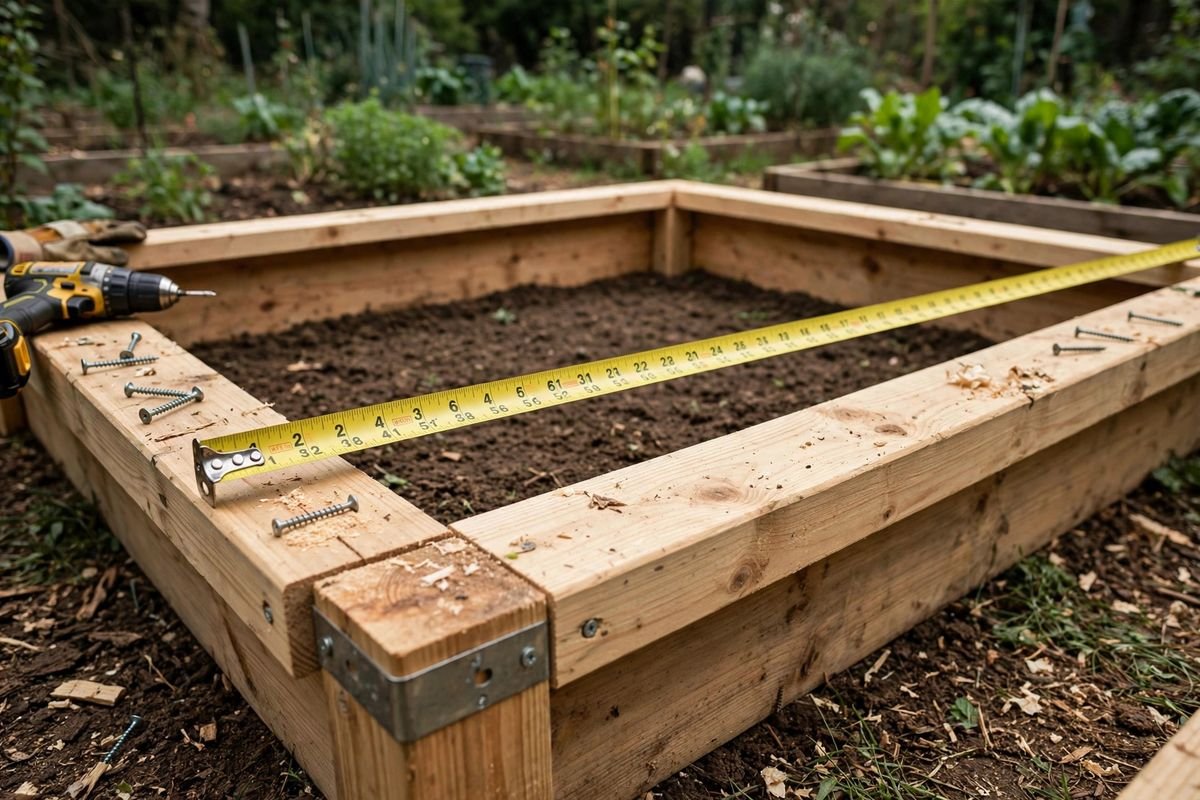
Width by crop and layout
For single-row crops like tomatoes on a trellis, a bed 2 feet wide is enough, since the plants grow up, not out. For square-foot planting with mixed crops, a 4-foot bed gives room for four rows or a grid, and every square stays within reach from one side or the other. For a bed against a wall, keep it 2 feet wide, and put tall crops at the back so they do not shade the front row.
Paths matter as much as beds. A path 2 feet wide fits a person and a bucket, but not a wheelbarrow. A path 3 feet wide fits a wheelbarrow and lets two people pass. If paths are too narrow, you will step into beds to pass, which compacts the soil you worked to keep loose. Plan paths first, then fit bed widths to what remains, not the other way around.

What to check before you build
Check your own reach before you fix a width. Stand at a table edge and reach forward comfortably, without straining your back. That distance, doubled for two-sided access, is your bed width. Check the site next: a bed wider than its paths allow will trap you, since you cannot reach the middle from either side without stepping in.
To compare current options, search for 4-foot wide raised garden beds and narrow 2-foot raised garden beds. Compare width and length first, then board height and bracing, then whether the kit suits your path plan. A bed that fits your reach and your paths will get used all season, while a bed that is too wide will slowly go weedy in the middle.

Questions
Can a bed be wider than 4 feet? Yes, if you add a stepping stone or a plank path through the middle, but that path eats growing area and needs to stay in place all season. A bed with a middle path is really two narrow beds joined at the frame.
Does bed length affect width? No, length can run as long as the garden allows, but very long beds need bracing so the sides do not bow outward under wet soil. Width is about reach, length is about the site.