
This post may contain affiliate links. If you buy through links on this page, we may earn a commission at no extra cost to you.
As an Amazon Associate I earn from qualifying purchases.
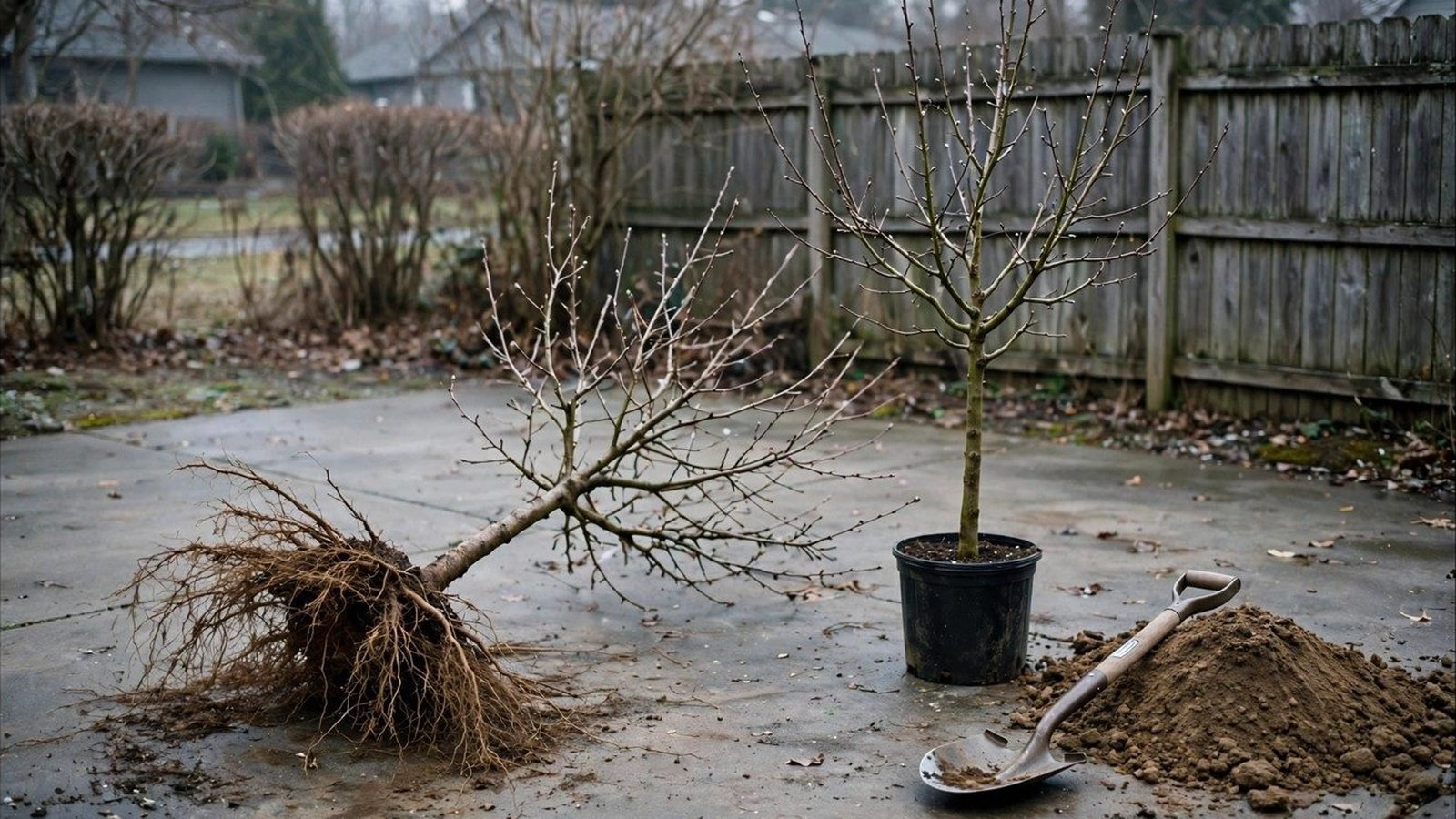
A fruit tree arrives in one of two forms. A bare-root tree is a dormant tree with no soil on its roots, usually wrapped in damp packing material and shipped in winter. A container tree is a growing tree in a pot of soil, bought from a nursery bench at almost any time of year. Both forms grow into the same tree. The difference is timing, handling, and how much you can see of the roots before you plant.
This guide compares the two forms side by side, works out the soil volume of a planting hole for each one, and compares the planting windows. For the list of trees that suit a winter planting, see our roundup of the best bare-root fruit trees to plant in winter. That roundup covers which trees to plant. This article covers the form to buy them in.
Bare-root vs container fruit trees at a glance
The table below gives the short version. The sections after it fill in the planting steps, the soil-volume math, and the planting windows.
| Trait | Bare-root | Container |
|---|---|---|
| What you get | A dormant tree with exposed roots and no soil | A growing tree in a pot of soil, often with leaves |
| When to buy | Late fall through early spring, while dormant | Almost any time of year, spring is best |
| When to plant | As soon as the ground can be worked, before growth starts | Any time during the growing season, spring is best |
| Root check | Full view of every root before planting | Roots hidden in the pot until you slide the tree out |
| Planting hole | Wide, twice the root spread, no deeper than the roots are long | About twice as wide as the pot, no deeper than the root ball |
| Choice of varieties | Widest choice, including rare types sold by mail | Limited to what the local nursery stocks |
| Handling | Roots must never dry out before planting | Root ball must stay intact when it leaves the pot |
Bare-root fruit trees: what they are and how to plant them
A bare-root tree is a young tree that a nursery dug up while it was dormant, shook the soil off, and packed with damp material around the roots. Apple, pear, peach, plum, and cherry trees are all sold this way. The tree looks like a stick with roots when it arrives, and that is normal. Judge it by the roots: healthy roots are moist, flexible, and pale inside when scratched, while dry, brittle, or blackened roots are a bad sign.
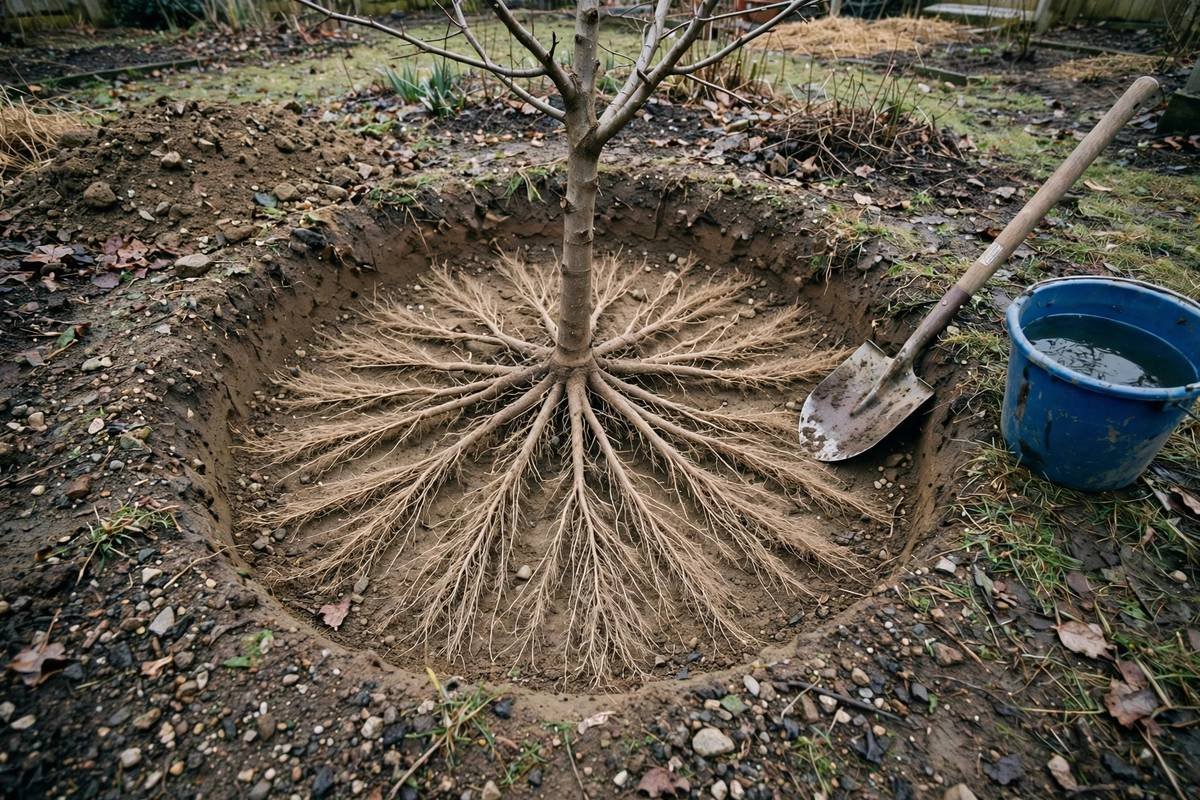
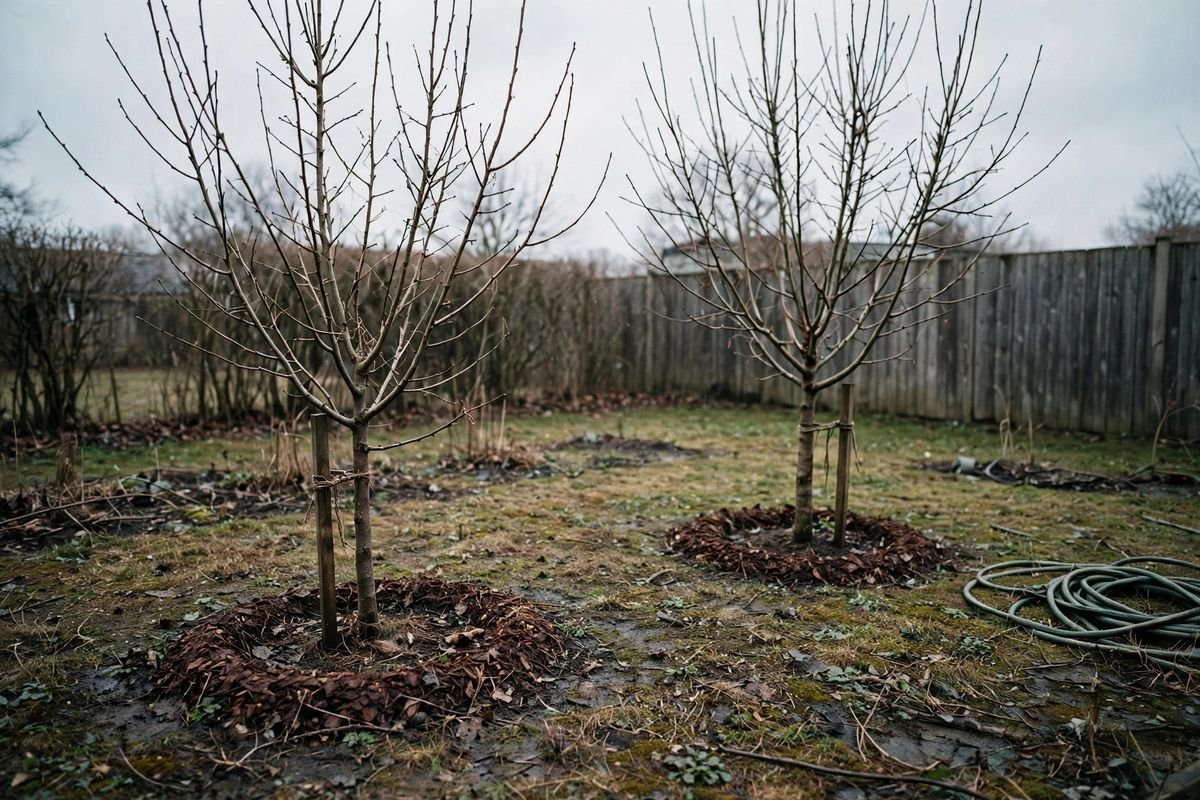
Plant a bare-root tree as soon as possible after it arrives, while it is still dormant and before visible growth starts. Soak the roots in a bucket of water for 2 to 4 hours before planting, and keep them moist at every step between the bucket and the hole. Dig the hole twice as wide as the root spread but no deeper than the roots are long, and build a small mound of soil in the center. Spread the roots out over the mound, with none bent or bunched, and set the tree so the graft union, the swelling where the variety meets the rootstock, sits about 4 inches above the soil line. Backfill with the soil you dug out, water it in well, and mulch 3 inches deep, keeping the mulch a few inches away from the trunk.
Prune a new bare-root tree at planting time, cutting the top back to shape the young tree and to balance the roots lost at digging. Water through the first year, because a new tree has a small root system and dries out fast in warm weather. For the pruning steps that follow planting, see our guide on how to prune fruit trees in winter.
If you need a digging tool for the wide hole, you can browse tree planting shovels on Amazon. We have not tested the products linked here, and we give no current store prices. Check each listing for current details before you buy.
Pros of bare-root trees
- Widest choice of varieties, including types a local nursery never stocks.
- You see every root before planting, so damaged roots are easy to spot and trim.
- Roots spread naturally in a wide hole, with no pot-bound circling to correct.
Cons of bare-root trees
- Narrow planting window, only while the tree is dormant and the ground is workable.
- Roots dry out fast, so the tree must be planted within days of arrival.
- No leaves to judge, so you buy on the nursery’s word about the variety.
Container fruit trees: what they are and how to plant them
A container tree is a young tree growing in a pot of soil, bought from a nursery bench with leaves on it in the growing season. The pot holds the roots and the soil together, so the tree can be planted almost any time the ground is workable. Small container trees, in 1 to 5 gallon pots, are the best buy. A tree that looks too large for its pot is often root-bound, and a very large potted tree is heavy and slow to settle in.
Before you buy, slide the tree partway out of the pot and look at the roots. Healthy roots are firm and pale, with some visible at the edge of the root ball but no solid mat circling the pot. If the roots circle the pot in a thick ring, score the root ball with a knife in several places before planting, so the roots grow outward instead of continuing in a circle.
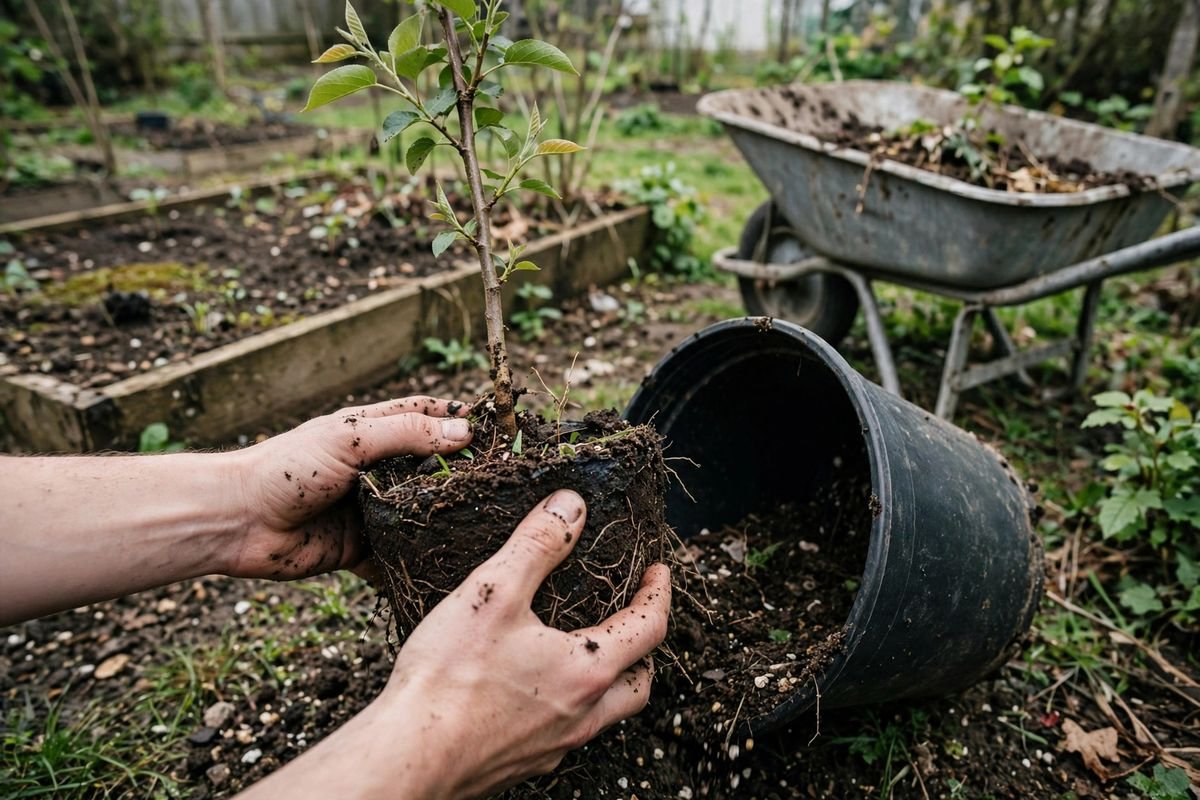
Dig the hole about twice as wide as the pot and no deeper than the root ball. Set the tree at the same depth it grew in the pot, with the graft union a few inches above the soil line, and fill the hole with the soil you removed. Do not amend the backfill with rich compost or fertilizer, because roots that stay in a pocket of soft soil do not spread into the surrounding ground. Water deeply right after planting, and keep watering through the first year, because a container tree planted in spring faces summer heat with a small root system.
A new container tree needs a stake in windy spots until the roots anchor it. If you need one, you can browse fruit tree stake kits on Amazon.
Pros of container trees
- Long planting window, any time during the growing season, with spring the best choice.
- You see the tree in leaf, so size and health are plain to judge.
- Easy to buy locally and take home the same day, with no shipping wait.
Cons of container trees
- Narrower choice of varieties, limited to what the nursery stocks.
- Roots can circle the pot, and a pot-bound tree grows slowly until the circling is fixed.
- Early-season container trees are sometimes bare-root trees potted up days before, sold at a container price.
Our worked example: how much soil comes out of the hole
The planting rule for both forms is the same: dig the hole twice as wide as the root spread, and no deeper than the roots are long. Here is the soil volume that rule produces for three common cases. These are our own computed numbers, with the assumptions stated in the table. The hole is treated as a cylinder, and the volume is pi times the radius squared times the depth, with pi taken as 3.14. One cubic yard holds 27 cubic feet.
| Tree | Root spread | Hole width | Hole depth | Soil volume |
|---|---|---|---|---|
| Bare-root apple, roots 24 inches across | 24 inches | 48 inches (4 feet) | 18 inches (1.5 feet) | 18.8 cubic feet, about 0.7 cubic yards |
| Bare-root peach, roots 18 inches across | 18 inches | 36 inches (3 feet) | 15 inches (1.25 feet) | 8.8 cubic feet, about 0.3 cubic yards |
| Container tree, 5-gallon pot, root ball 12 inches across | 12 inches | 24 inches (2 feet) | 12 inches (1 foot) | 3.1 cubic feet, about 0.1 cubic yards |
The math for the apple tree runs like this. The hole is 4 feet across, so the radius is 2 feet. The depth is 1.5 feet. Volume is 3.14 times 2 squared times 1.5, which is 3.14 times 4 times 1.5, or 18.8 cubic feet. Divide by 27 to get cubic yards, and the answer is about 0.7 cubic yards, most of a wheelbarrow load.
Two things stand out from the table. First, the bare-root hole is far bigger than the container hole, because the root spread is bigger and the hole is twice that spread: a bare-root apple needs about six times the soil moved of a 5-gallon container tree. Second, the volume grows fast with width, because the radius is squared. Widening a hole from 3 feet to 4 feet across more than doubles the soil you move, so allow room beside the hole for the pile, and dig when the soil is moist but not wet.
The backfill is the soil you dug out, put back in the same hole, with no amendment mixed in. Roots grow out of the hole into the surrounding soil, and they do that best when the backfill matches the soil around it. A hole filled with soft compost makes a comfortable pocket that roots never leave, and the tree stays shallow-rooted and unstable, so keep the dug soil in a pile and put the same soil back.
Planting windows compared
The planting window is the real difference between the two forms. A bare-root tree must be planted while it is dormant, which means late fall through early spring in most climates, as soon as the soil can be worked. A container tree can be planted any time during the growing season, though spring is the best choice, because the tree gets a full season to root in before winter. In cold climates, a container tree planted in late fall may not root in before the ground freezes, so spring is the safer choice there.
| Climate | Bare-root window | Container window |
|---|---|---|
| Cold, ground frozen in winter | Early spring, as soon as the ground can be worked | Spring through early summer |
| Cool, mild winters | Late fall through early spring | Spring through fall |
| Warm, no hard freeze | Late fall through winter | Almost any time, avoiding the hottest weeks |
Use your local frost dates and regional planting guidance — not your USDA hardiness zone alone — to choose planting dates. A zone number tells you how cold the winter gets, not when your last frost arrives, and two gardens in the same zone can sit weeks apart on frost dates. Your local extension planting calendar is the better guide for the exact dates in your town. For winter care after planting, see our guide on how to protect fruit trees from frost.
Which form should you choose?
Choose bare-root if you want the widest choice of varieties, if you are planting in late fall or early spring, or if you want to inspect every root before the tree goes in the ground. Bare-root fits a gardener who plans ahead and plants on the first workable day of spring.
Choose container if you missed the bare-root season, if you want to see the tree in leaf before you buy, or if you need a tree in the ground this week rather than next spring. Container fits a gardener who shops at a local nursery, picks the tree by eye, and plants it the same day.
Either form grows into a good tree when it is planted at the right depth, watered through the first year, and pruned to shape. The form matters less than the timing and the aftercare: a bare-root tree planted on time and watered well will outgrow a container tree planted late and left dry, and the reverse is just as true. Pick the form that fits your calendar, then do the planting steps right.
Troubleshooting
The bare-root tree never leafs out in spring
A bare-root tree that never leafs out was often planted too deep, dried out before planting, or set in frozen or waterlogged soil. Check the soil line on the stem at planting time, soak the roots first, and skip planting when the ground is frozen. Scratch a small twig in spring: green under the bark means the tree is alive and late, while brown and dry means it did not survive.
The container tree wilts right after planting
A container tree that wilts in its first week usually has a root ball that dried out, or roots still circling the pot and not taking up water. Water deeply, soaking the whole root ball all the way through, and shade the tree on hot afternoons for the first week. If the tree was pot-bound and the root ball was not scored, dig it up, score the roots, and replant it.
Frequently asked questions
How soon after planting will a fruit tree bear fruit?
It depends on the rootstock and the type. Apple trees on dwarf rootstocks start bearing 2 to 3 years after planting, while standard trees can take up to 8 years. Stone fruits often fruit sooner than apples. The first year is for roots, not fruit.
Do I need two trees for fruit?
Many fruit trees need pollen from a different variety to set fruit. Apples need two different varieties, and one can be a crabapple. Some stone fruits and some newer apple types are self-fertile, so one tree is enough. Check the variety before you buy.
Should I amend the soil in the planting hole?
No. Fill the hole with the soil you dug out, with no compost or fertilizer mixed in. Roots stay in a pocket of amended soil and do not spread into the surrounding ground, which leaves the tree shallow-rooted. Compost belongs on the surface as mulch.
Sources and further reading
- University of Minnesota Extension, Growing apples in the home garden
- University of Minnesota Extension, Growing stone fruits in the home garden
- North Carolina State University Extension, Fig Culture in North Carolina
Related reading: Best Bare-Root Fruit Trees to Plant in Winter, How to Prune Fruit Trees in Winter, How to Protect Fruit Trees from Frost
By the Pot and Plot Team