
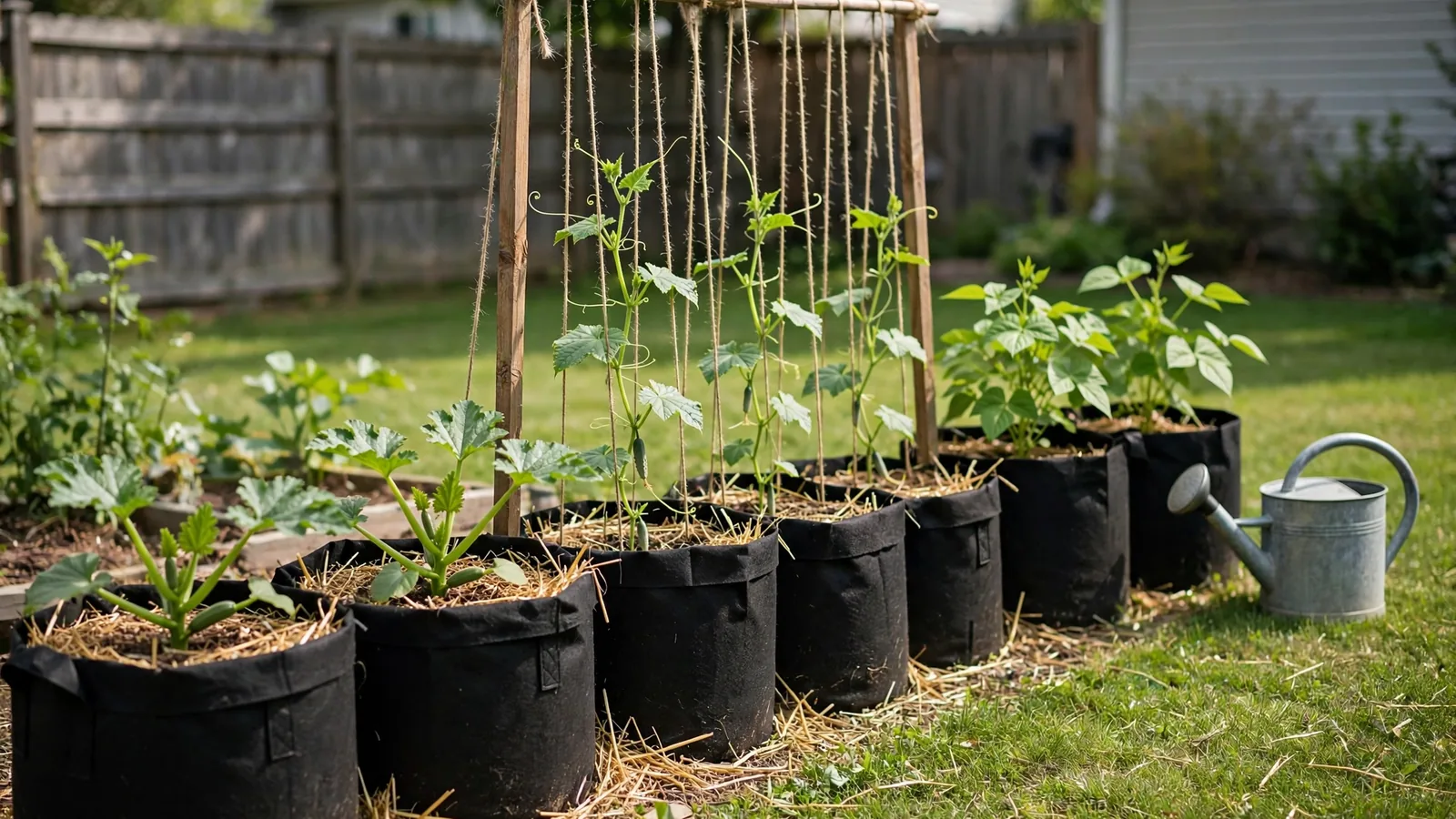
Gardening has a reputation for being expensive — $70 bed kits, $110 in bagged soil, and suddenly a tomato costs $40. It doesn’t have to. This plan grows five kinds of vegetables for under $150 total, using grow bags instead of lumber, seeds instead of transplants, and a shopping list with no filler. Every dollar is accounted for below, and the math is shown.
This is a planning guide, not a grow log. The layout diagram and header image are AI-generated illustrations (labeled as such) — they show the arrangement, not a real garden.
Who this setup is for
A beginner who wants to prove the concept before investing — or anyone whose budget is the binding constraint. This plan makes no apologies: grow bags aren’t as pretty as cedar beds, but they grow the same zucchini for one-tenth the container cost.
Space required
About 30 square feet — a 5×6-foot patch of sunny yard, driveway edge, or patio. Five grow bags in a row or a loose cluster, with room to walk between them. Grow bags sit directly on the ground (or pavement); put a tarp or old shower curtain underneath on a patio to catch drainage stains.
Sun requirements
6+ hours of direct sun. Budget doesn’t change biology — the crops below all need full sun. No shady corner will do; if shade is what you have, the shady patio plan is the honest alternative.
The layout
Five 7-gallon grow bags in a row. Set the row so the taller crops (zucchini, cucumber) sit on the north end and won’t shade the low greens:
- Bag 1: Zucchini (‘Black Beauty’) — 1 plant
- Bag 2: Cucumber (‘Marketmore 76’) — 2 plants + a simple string trellis
- Bag 3: Bush beans (‘Provider’) — 6 plants
- Bag 4: Lettuce (‘Salad Bowl’) — 6 plants, cut-and-come-again
- Bag 5: Radishes (‘Cherry Belle’) — sow thickly, succession every 2 weeks
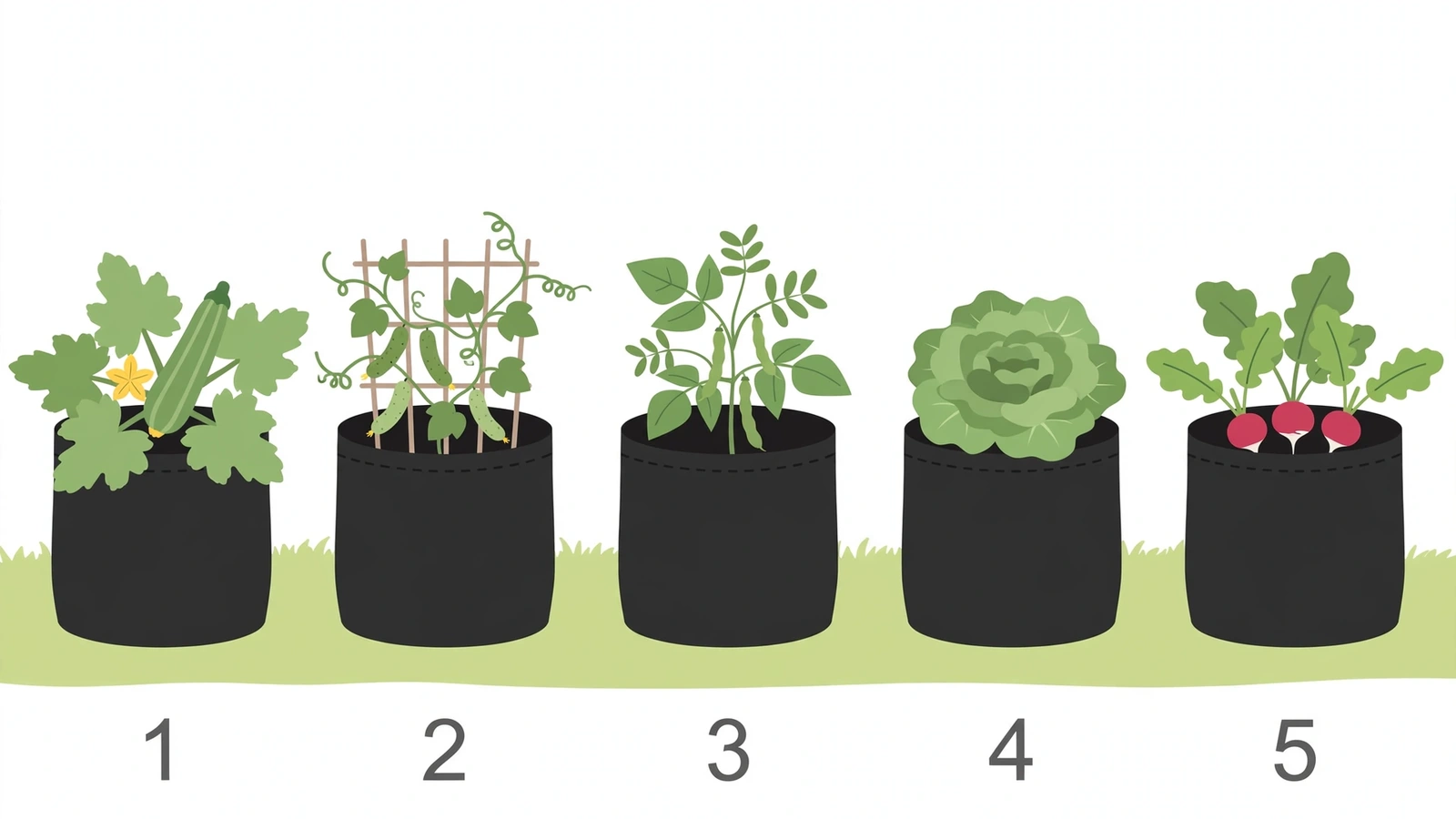
Illustration: overhead diagram of five labeled grow bags in a row — zucchini, cucumber, beans, lettuce, and radishes.
What to plant: specific varieties
Everything here grows from seed sown directly — no transplants, which saves $20–$30 versus buying starts. These five are the most forgiving seeds in the vegetable world:
| Bag | Crop | Variety | Notes |
|---|---|---|---|
| 1 | Zucchini | ‘Black Beauty’ | Sow 2 seeds, keep the stronger seedling; harvest small and often |
| 2 | Cucumber | ‘Marketmore 76’ | Disease-resistant; trellis it or it eats the row |
| 3 | Bush beans | ‘Provider’ | Germinates in cool soil; pick every 2–3 days at peak |
| 4 | Lettuce | ‘Salad Bowl’ | Sow a short row every 3 weeks for continuous salad |
| 5 | Radish | ‘Cherry Belle’ | Ready in ~25 days — the fastest payoff in the garden |
Total seed cost: five packets at $3–$4 each. One packet of beans plants this bag for three years.
Containers, soil, and the math
Grow bags are the budget breakthrough: a 5-pack of 7-gallon fabric bags costs about $16–$20 (roughly $3.50 each). They drain well, air-prune roots (no circling), and fold flat for winter storage. The tradeoff: they dry out faster than plastic pots, so mulch the tops and stay on top of watering.
Soil volume — 1 gallon = 0.134 cubic feet:
- 5 bags × 7 gal = 35 gallons
- 35 × 0.134 = 4.7 cubic feet
Buy 5 cubic feet: three 1.5-cu-ft bags (4.5) plus one 1-cu-ft bag, or four 1.5-cu-ft bags (6 cu ft) and use the extra to top-dress mid-season. At ~$10 per 1.5-cu-ft bag of raised-bed mix, four bags = $40. Fill bags to 1 inch below the rim — soil settles.
Watering
Grow bags dry faster than any other container — in summer heat, check daily. The finger test (2 inches deep) is your instrument. Water until it seeps from the sides, which is the grow-bag equivalent of drainage holes working. A 2–3 inch straw mulch layer on each bag cuts watering frequency noticeably and costs almost nothing. If you own a hose, a $15 twist nozzle is the only watering gear you need. One more honest note: fabric bags wick moisture from their sides on windy days, so a sheltered spot against a fence or wall waters less often than an exposed one.
Keep a small reserve of soil and seed: when the radishes finish in June, sow bush beans in Bag 5 for a fall crop, and when the lettuce bolts in summer heat, re-sow it in late August for fall salads. The bags are reusable infrastructure — the $124 keeps paying long after the first harvest.
Equipment list
- 5 × 7-gallon grow bags
- 5–6 cu ft raised-bed or potting mix
- 1 small bale of straw (mulch)
- 5 seed packets (zucchini, cucumber, beans, lettuce, radish)
- All-purpose granular fertilizer (one small box)
- String + two stakes (cucumber trellis)
- Trowel
- Hose nozzle or watering can
Estimated budget: the full accounting
Typical US retail, September 2026. This is the whole list — nothing hidden:
| Item | Est. cost |
|---|---|
| 5-pack of 7-gallon grow bags | $18 |
| 4 bags soil mix (1.5 cu ft) | $40 |
| Straw mulch (small bale) | $8 |
| 5 seed packets | $18 |
| Granular fertilizer (4-lb box) | $13 |
| String + 2 stakes | $5 |
| Trowel | $10 |
| Hose nozzle | $12 |
| Total | $124 |
$124 — $26 under budget. That cushion covers tax, a second bag of mulch, or replacing the seeds you spill on the patio (everyone does it once).
Must buy / Nice to have / Skip
Must buy: the bags, the soil, the seeds. The $76 core. Everything else improves odds; these three are the garden.
Nice to have (still under $150): a $10 bag of compost to mix into each bag at planting, plant labels, a second sowing of lettuce seed in late summer ($4).
Skip: “premium” grow bags at $12 each (the $3.50 ones last 3–4 seasons), bagged “garden soil” instead of potting/raised-bed mix in containers (it compacts — this is the one place not to economize), and buying transplants “to get ahead” (it blows the budget and these crops don’t need the head start).
What changes the plan
- Have $150 but no sun? Spend it differently — the shady plan uses the same bags with shade-tolerant crops.
- Already own pots? Use them. A 5-gallon bucket with drilled holes replaces a grow bag; the soil math is identical.
- Want tomatoes too? They need bigger pots and transplants — that’s a different budget. Add them in year two with the 6-pot balcony plan as a template.
- Clay soil and no patio? Set the bags right on the grass. They’ll smother it into a future bed site by fall — free site prep.
- No hose? A 2-gallon watering can works — you’ll refill it 3–4 times per watering session in July. Fill it the night before so the water reaches air temperature; cold water on hot roots stresses the plants.
When to sow each crop in your climate: Garden Pulse gives you this week’s window, and Start Seeds builds the full calendar.
Related guides and tools
- Container Garden Builder — pots, plants, and care plans for small spaces
- Raised Bed Builder — when you’re ready to upgrade to a bed
- Start Seeds — sowing dates for your ZIP code
- All garden tools — browse every free tool
- Garden Pulse — what to do in your garden right now
- Garden Inbox — your planting windows, tracked week by week